




What's Happening?
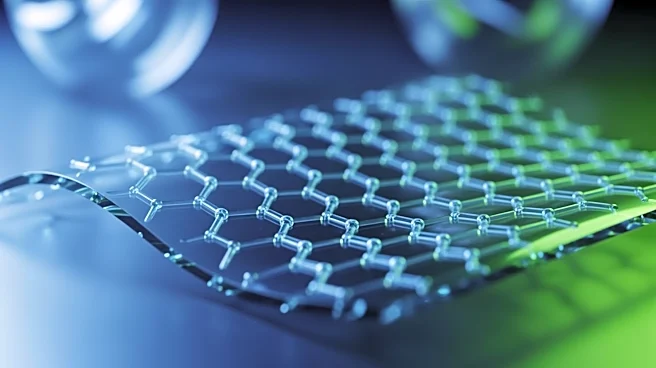
Researchers from Tohoku University and other institutions have developed a new class of heteroatom-engineered covalent organic framework (COF)-based mixed matrix membranes (MMMs) that significantly enhance carbon dioxide (CO2) separation performance.
These new membranes surpass the 2008 Robeson upper bound, a long-standing benchmark for gas separation membranes. The breakthrough was achieved by designing two new porous materials that interact strongly with CO2, allowing for both rapid transport and accurate separation from other gases like methane and hydrogen. This development addresses the traditional permeability-selectivity trade-off faced by conventional membranes, which either allow CO2 to pass quickly but with poor separation or achieve high selectivity at the cost of slower CO2 flow.
Why It's Important?
The advancement in CO2 separation technology is crucial for industries such as natural gas upgrading, hydrogen purification, and carbon capture, which currently rely on energy-intensive methods like amine scrubbing and cryogenic separation. The new COF-based membranes offer a more energy-efficient alternative, potentially reducing operational costs and environmental impact. By overcoming the intrinsic trade-off between permeability and selectivity, these membranes could lead to more sustainable industrial processes and contribute to global efforts in reducing carbon emissions. The ability to efficiently separate CO2 from other gases is a key component in managing carbon emissions and mitigating climate change.
What's Next?
The research team plans to further explore the potential of heteroatom-engineered COFs in practical applications. Future studies may focus on scaling up the production of these membranes and testing their performance in real-world industrial settings. Additionally, the insights gained from this research could inspire the development of other advanced materials for gas separation and carbon capture. As industries seek to adopt more sustainable practices, the demand for efficient and cost-effective separation technologies is likely to grow, potentially leading to wider adoption of these innovative membranes.
Beyond the Headlines
This development highlights the importance of material science in addressing environmental challenges. The precise engineering of COFs to enhance gas separation performance demonstrates how targeted modifications at the molecular level can lead to significant improvements in industrial processes. The success of this research could encourage further exploration of COFs and similar materials in other applications, such as water purification and energy storage, broadening the impact of this technology beyond carbon capture.