
What's Happening?
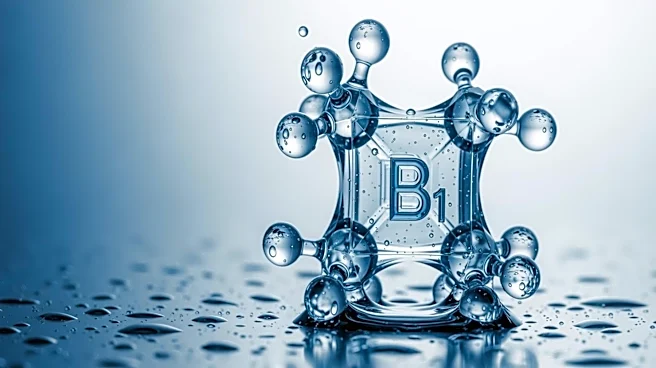
Chemists have successfully stabilized a reactive carbene in water, confirming a 67-year-old theory related to vitamin B1. This breakthrough was achieved by creating, isolating, and sealing a carbene in a tube,
observing its stability for months in water. Carbenes are typically unstable due to having only six valence electrons, but the research team used a protective molecular structure to maintain its integrity. This discovery supports Ronald Breslow's 1958 hypothesis that vitamin B1 could form a carbene-like structure to drive biochemical reactions. The study, published in Science Advances, marks the first observation of a stable carbene in water, providing experimental evidence for Breslow's theory.
Why It's Important?
The stabilization of carbenes in water has significant implications for chemistry and manufacturing. Carbenes are used in metal-based catalysts for producing pharmaceuticals, fuels, and other materials, often relying on toxic organic solvents. This discovery suggests a potential shift towards safer, environmentally friendly production methods using water as a solvent. Water is abundant, non-toxic, and environmentally friendly, making it an ideal medium for chemical reactions. The findings could lead to cleaner manufacturing processes, reducing reliance on harmful solvents while maintaining effectiveness in catalytic chemistry.
What's Next?
The study provides a proof of concept for stabilizing reactive intermediates in water, but further research is needed to explore its broader applications. Chemists will need to test water-based catalytic systems more seriously to determine if this approach can be applied to other carbenes and catalytic processes. The immediate beneficiaries are researchers and the chemistry community, who now have a new model for studying reactive intermediates. Pharmaceutical production could also benefit if these findings translate into cleaner methods. The challenge remains in adapting this discovery for widespread industrial use without compromising precision or safety.
Beyond the Headlines
This breakthrough highlights the importance of scientific persistence, turning a once-dismissed theory into measurable evidence. It demonstrates how basic research can have industrial implications, potentially leading to greener production methods. The discovery is a milestone in structural chemistry and cleaner manufacturing, but it does not promise a complete solution. The public should recognize the value of scientific research in addressing environmental challenges and the potential for innovation in chemical production.