






What's Happening?
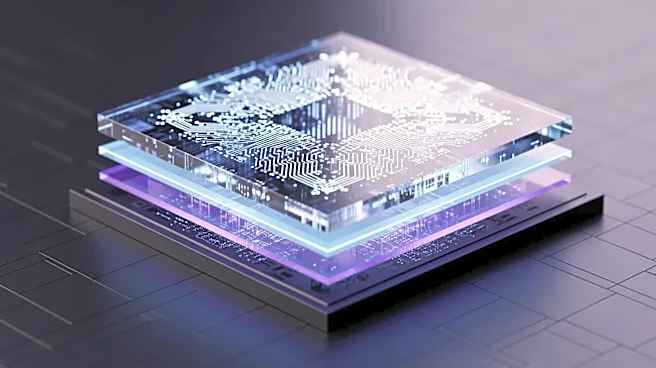
Researchers from Huazhong University of Science and Technology and Shanghai Jiao Tong University have developed a programmable photonic neural network chip, which has been published in Nature Communications. This chip, constructed within glass, enables
direct on-chip optical processing of two-dimensional images. It achieves a classification accuracy of 93% for MNIST handwritten digits and a theoretical computational throughput of 6554 TOPS. The chip's architecture involves a two-dimensional space input, three-dimensional light field mixing, programmable phase regulation, and on-chip neural network inference. This development marks a significant step in optical computing, allowing light to be used not only for data transmission but also as part of the computing process itself.
Why It's Important?
The development of this photonic neural network chip represents a major advancement in AI hardware, particularly in the field of optical computing. By utilizing light for computation, the chip offers potential benefits such as higher bandwidth and lower power consumption compared to traditional electronic computing. This innovation could lead to more efficient AI systems, impacting industries reliant on large-scale data processing and AI inference. The ability to process two-dimensional images directly on-chip without converting them into one-dimensional data streams could enhance the speed and efficiency of image-based AI applications.
What's Next?
The next steps for this technology involve scaling up the chip's capabilities and integrating it into larger AI systems. Researchers will likely focus on improving the chip's programmability and data handling capacity to support more complex AI tasks. Additionally, the industry may explore commercial applications of this technology, potentially leading to new products and services in sectors such as autonomous vehicles, healthcare imaging, and smart city infrastructure. Collaboration with tech companies could accelerate the development and deployment of this optical computing technology.
Beyond the Headlines
This development highlights the potential for optical computing to transform the AI landscape by leveraging the unique properties of light. The use of three-dimensional space within the chip allows for more complex data processing, which could lead to breakthroughs in AI efficiency and capability. Furthermore, this innovation underscores the importance of interdisciplinary research, combining insights from physics, engineering, and computer science to push the boundaries of what is possible in computing technology.