





What's Happening?
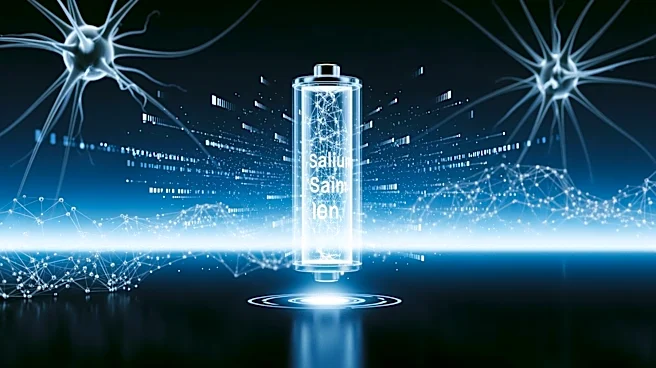
Researchers at UC San Diego have leveraged a supercomputer and artificial intelligence to enhance sodium-ion battery materials, potentially reducing the cost of large-scale energy storage for power grids. By using the Expanse supercomputer, the team studied
material changes in battery cathodes, discovering that adding lithium and titanium significantly improved energy storage and battery life. Sodium-ion batteries, seen as a cost-effective alternative to lithium-ion cells, are crucial for renewable energy storage. The modifications allowed the batteries to store more energy and remain stable under high-voltage conditions, addressing previous performance and degradation issues.
Why It's Important?
This development is significant for the energy sector, particularly in the context of renewable energy storage. Sodium-ion batteries offer a cheaper alternative to lithium-ion batteries, which are currently dominant but expensive due to limited lithium resources. By improving sodium-ion battery performance, the research could lead to more affordable and efficient energy storage solutions, facilitating the integration of renewable energy sources like solar and wind into the power grid. This advancement could accelerate the transition to sustainable energy systems, reduce reliance on fossil fuels, and support efforts to combat climate change.
What's Next?
The research team plans to continue refining the sodium-ion battery technology, with a focus on further improving performance and reducing costs. The use of supercomputers and AI in material science is expected to play a crucial role in future developments, allowing for rapid testing and optimization of new battery materials. As the technology matures, it could lead to the deployment of large-scale battery farms, enhancing grid stability and energy security. The findings also open up possibilities for collaboration with industry partners to commercialize the technology and integrate it into existing energy infrastructure.