








What's Happening?
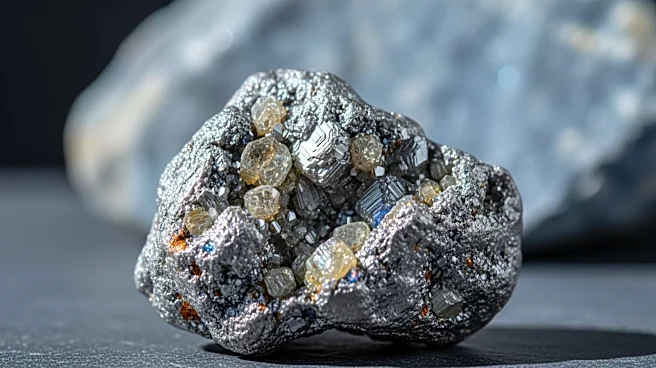
Researchers from the University of Cambridge have developed a new atlas that maps the global distribution of CO2-rich igneous rocks, which are primary sources of rare earth elements (REEs). These elements are crucial for the production of various technologies,
including smartphones and clean energy solutions. The study, published in Nature Geoscience, highlights that these rocks often form near the thick and ancient cores of major continents. The research team, led by Dr. Emilie Bowman, found that the distribution of these rocks is closely linked to variations in the Earth's lithosphere. The thicker lithosphere allows pockets of molten rock to become trapped and concentrate metals, providing a predictive tool for locating new REE deposits.
Why It's Important?
The findings are significant as they offer a method to predict the location of rare earth element deposits, which are essential for many modern technologies. Currently, much of the world's supply of REEs comes from China, raising concerns about supply security and sustainability. By identifying potential domestic sources, countries can reduce their dependency on imports and enhance their resource security. This research not only aids in the discovery of new deposits but also contributes to the understanding of geological processes that lead to the formation of these critical resources.
What's Next?
The research team plans to extend their mapping efforts to include rocks older than 200 million years, which host most of the economic REE deposits globally. This extension aims to provide a more comprehensive understanding of the geological history and processes that lead to the formation of REE deposits. The ongoing research could lead to more efficient exploration strategies and potentially uncover new sources of these vital elements.