







What's Happening?
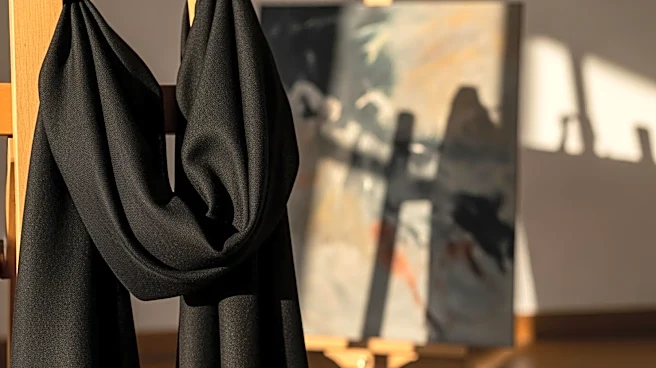
An early portrait by the renowned British artist Lucian Freud, titled 'Man in a Black Scarf', is set to be exhibited for the first time after experts authenticated it as Freud's work. The painting, created in 1939 while Freud was a student at the East
Anglian School of Painting and Drawing in Hadleigh, Suffolk, depicts John Jameson, a friend of Freud and a member of the whiskey family. Despite Freud's repeated denials of authorship before his death in 2011, new evidence has emerged supporting the painting's authenticity. The work gained attention after being featured on the BBC's 'Fake or Fortune?' show in 2016, where art historian Philip Mould suggested it was likely a Freud. The denial of authorship was reportedly linked to a personal feud between Freud and the painting's original owners, Denis Wirth-Miller and Richard Chopping. The painting will be displayed at the Garden Museum in London as part of the 'Benton End: A Paradise of Pollen and Paint' exhibition.
Why It's Important?
The authentication and exhibition of 'Man in a Black Scarf' highlight the complexities of art provenance and the impact of personal relationships on artistic legacies. This development not only enriches the understanding of Freud's early work but also underscores the influence of his mentor, Cedric Morris, on his artistic style. The exhibition provides an opportunity to explore the connections between Freud and the East Anglian School of Painting and Drawing, offering insights into the formative years of one of Britain's most celebrated artists. The painting's authentication could also influence its market value, as Freud's works are highly sought after, with some fetching millions at auction. This event may prompt further investigations into other disputed works, potentially reshaping the art historical narrative surrounding Freud.
What's Next?
The exhibition at the Garden Museum will allow art enthusiasts and scholars to view 'Man in a Black Scarf' and assess its significance within Freud's oeuvre. The painting's authentication may lead to increased interest in other works from Freud's early period, potentially prompting further research and exhibitions. Additionally, the exhibition could spark renewed interest in the East Anglian School of Painting and Drawing, highlighting its role in shaping the careers of prominent artists like Freud. The art market may also see heightened activity around Freud's works, as collectors and institutions seek to acquire authenticated pieces.
Beyond the Headlines
The authentication of 'Man in a Black Scarf' raises questions about the role of personal biases in art attribution and the challenges of verifying authorship posthumously. It also highlights the importance of archival research and expert analysis in resolving disputes over art provenance. The exhibition may encourage a reevaluation of other works associated with Freud and his contemporaries, potentially leading to new discoveries and insights into the art world of the mid-20th century. This case underscores the ongoing dialogue between art history, market forces, and personal narratives in shaping the legacy of influential artists.