



What's Happening?
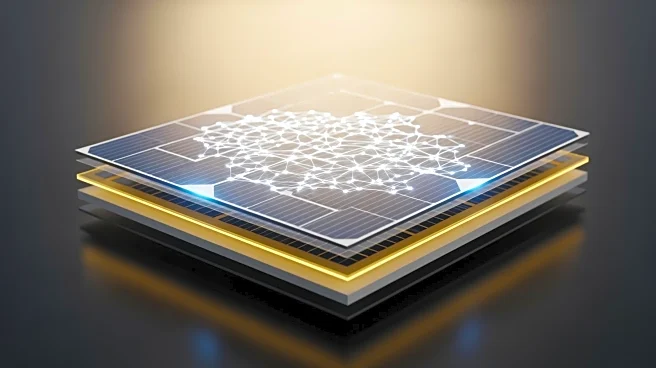
Researchers from the Qingdao Institute of Bioenergy and Bioprocess Technology, in collaboration with international partners, have developed a method to enhance the performance of perovskite solar cells (PSCs). By engineering a two-dimensional perovskite phase at the buried interface of three-dimensional PSCs, they achieved a power conversion efficiency (PCE) of 26.19% for small-area devices. This advancement was made possible by using SnO2-TGA-OAm nanoparticles as a multifunctional electron-transporting layer, which improved the crystallization quality of perovskite films and reduced defect concentrations. The study, published in Nature Energy, highlights the potential for scalable production and commercialization of PSCs.
Why It's Important?
The breakthrough in
perovskite solar cell efficiency represents a significant step towards the commercialization of this promising photovoltaic technology. With higher efficiency and improved operational stability, PSCs could become a viable alternative to traditional silicon-based solar cells. This development has the potential to accelerate the adoption of renewable energy solutions, contributing to global efforts to reduce carbon emissions and combat climate change. The ability to produce high-efficiency solar cells at scale could also drive down costs, making solar energy more accessible and affordable.
What's Next?
The research team plans to further explore the scalability of their method for industrial production. The successful commercialization of PSCs could lead to increased investment in renewable energy technologies and infrastructure. As the demand for clean energy solutions grows, advancements in solar cell technology will play a crucial role in meeting global energy needs sustainably. The continued development of PSCs may also spur innovation in related fields, such as energy storage and grid integration, further enhancing the viability of renewable energy systems.