



What's Happening?
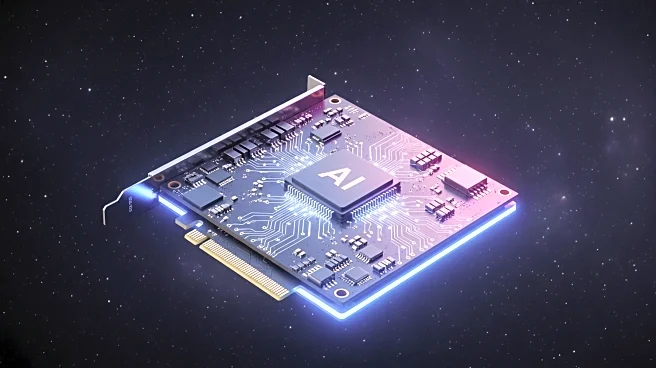
Spacechips, a U.K.-based space consultancy and design firm, in collaboration with Vicor, a modular power-component company, has developed a compact artificial intelligence (AI) accelerator card designed for in-orbit applications. The AI1 transponder, a small on-board processor card, features an adaptive compute acceleration platform (ACAP) AI accelerator. This technology is capable of delivering up to 133 tera operations per second (TOPS) of performance, supporting applications such as Earth observation, in-space servicing, assembly and manufacturing (ISAM), signals intelligence (SIGINT), and intelligence, surveillance, and reconnaissance (ISR). The AI1 transponder is designed to enable real-time, autonomous computing while ensuring reliability
and longevity for extended missions. The partnership leverages Vicor's Factorized Power Architecture (FPA) to enhance power efficiency and flexibility, crucial for the constrained operating environment of space.
Why It's Important?
The development of the AI1 transponder represents a significant advancement in space technology, particularly in the realm of autonomous computing. By enabling real-time data processing in orbit, the technology addresses the bandwidth limitations faced by spacecraft operators, who often struggle to download all acquired data for real-time processing. This innovation could lead to more efficient space missions, reducing the need for extensive ground-based data processing. The collaboration between Spacechips and Vicor highlights the growing importance of precision power management in space applications, as missions increasingly rely on solar power. The AI1's ability to perform high-performance computing tasks with reduced size and weight could set a new standard for future space missions, potentially impacting industries involved in space exploration, telecommunications, and defense.
What's Next?
As the AI1 transponder becomes operational, it is expected to undergo further testing and validation in various space missions. The success of this technology could prompt other companies and space agencies to adopt similar AI-driven solutions for in-orbit applications. Additionally, the partnership between Spacechips and Vicor may lead to further innovations in power management and AI technology for space, potentially expanding the scope of autonomous operations in space missions. Stakeholders in the aerospace and defense industries will likely monitor the performance of the AI1 closely, as its success could influence future investments and technological developments in the sector.