
What's Happening?
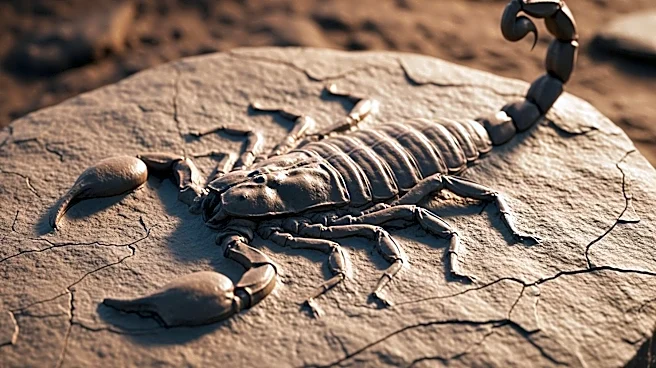
Scientists have confirmed that fossil fragments found in the United Kingdom belong to Praearcturus gigas, the largest scorpion ever identified, which lived approximately 415 million years ago. This prehistoric
species is believed to have measured over three feet in length, significantly larger than modern scorpions. The discovery was made through a new analysis led by Dr. Richie Howard from the Natural History Museum, which settled a long-standing debate about the creature's identity. The findings suggest that the giant scorpion thrived during a time when life on land was still developing, possibly due to a lack of competition from other large predators.
Why It's Important?
The identification of Praearcturus gigas provides valuable insights into the evolution of early land-based ecosystems and the diversity of prehistoric life. Understanding the characteristics and behaviors of such ancient species helps scientists reconstruct the ecological dynamics of the Devonian Period, offering clues about the evolutionary pressures that shaped modern biodiversity. This discovery also highlights the importance of paleontological research in uncovering the history of life on Earth, contributing to our knowledge of how current ecosystems have evolved over millions of years.
Beyond the Headlines
The study of Praearcturus gigas not only enriches our understanding of prehistoric life but also raises questions about the factors that allowed such large arthropods to exist. The absence of large vertebrate predators during the Early Devonian may have enabled these scorpions to dominate their environment. This research could lead to further investigations into the evolutionary pathways of arthropods and their adaptations to changing environments over geological time scales.