








What's Happening?
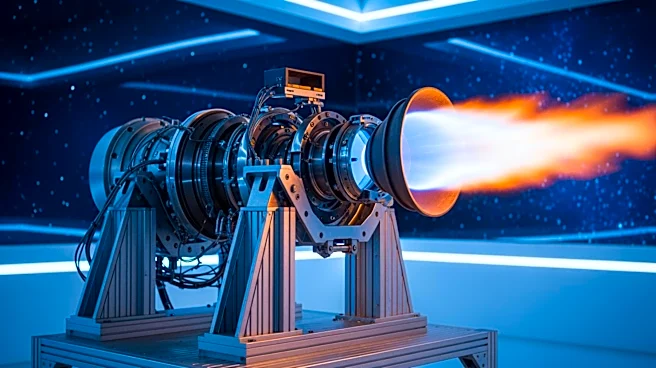
Stellar Alpina, a Swiss propulsion startup, has successfully raised $4.5 million in a pre-seed funding round to develop rotating detonation rocket engines (RDRE). These engines are anticipated to provide more efficient in-space mobility compared to traditional
chemical propulsion systems. The funding round was led by Founderful, with participation from Swiss VC LP&E. The company, founded by engineers from Switzerland's Academic Spaceflight Initiative, aims to design and test RDREs rapidly, having already achieved a hotfire test within 82 days of its founding. Stellar Alpina plans to conduct frequent engine tests over the next year and aims to have a spaceflight-ready RDRE by 2028. The company is also looking to expand its team and build a higher-class test stand to support larger engine tests.
Why It's Important?
The development of RDREs by Stellar Alpina represents a significant advancement in propulsion technology, potentially offering greater efficiency and a higher thrust-to-weight ratio than traditional engines. This innovation could revolutionize space travel by providing more compact and efficient propulsion systems, which are crucial for long-duration missions and deep space exploration. The successful commercialization of RDREs could position Stellar Alpina as a leader in the aerospace industry, potentially influencing the market dynamics and competitive landscape. The funding and rapid development timeline underscore the growing interest and investment in advanced propulsion technologies, which are essential for the future of space exploration and satellite deployment.
What's Next?
Stellar Alpina plans to continue its aggressive testing schedule, aiming to fire a new engine configuration every two weeks. The company is also focused on expanding its workforce and infrastructure to support larger-scale tests. As the company progresses, it will seek to engage with potential customers to identify market needs and tailor its technology to meet demand. The success of these efforts could lead to partnerships with major aerospace companies and government agencies, further accelerating the adoption of RDRE technology in various space applications.