
What's Happening?
Opentrons is leveraging Nvidia's AI platforms, Isaac and Cosmos, to enhance the development of physical AI-enabled laboratory robotics. This collaboration aims to improve laboratory workflows by using
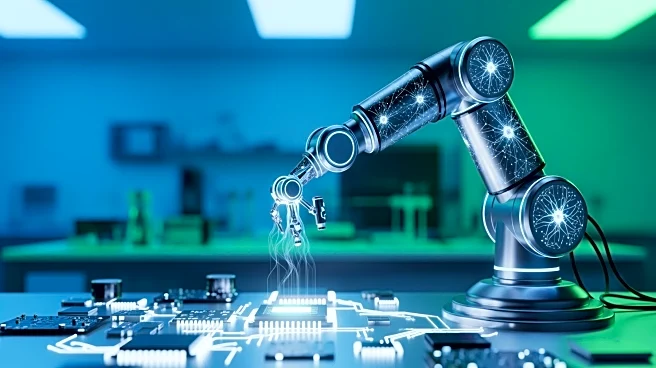
AI to automate tasks traditionally performed by humans. Opentrons has installed over 10,000 robotic systems in research institutions and biopharmaceutical companies, and this partnership with Nvidia will enable the creation of digital twins and simulation environments to train AI models. The goal is to achieve true autonomous science, where AI can design experiments and execute them using robotic systems, streamlining laboratory processes and accelerating scientific discovery.
Why It's Important?
The integration of AI in laboratory automation represents a significant advancement in scientific research and development. By automating routine tasks, AI can increase efficiency and reduce human error, allowing scientists to focus on more complex and creative aspects of research. This collaboration between Opentrons and Nvidia could lead to breakthroughs in drug discovery, biotechnology, and other fields that rely on precise and efficient laboratory work. As AI continues to evolve, it has the potential to transform the way research is conducted, leading to faster and more cost-effective scientific advancements.
What's Next?
Opentrons plans to continue developing and refining its AI models throughout 2026, with the goal of making them available to select customers in 2027. The success of this initiative could pave the way for broader adoption of AI in laboratories worldwide, driving innovation and efficiency in scientific research. As AI technology becomes more sophisticated, it may also lead to new applications and opportunities in other industries, further expanding its impact on society and the economy.