


What's Happening?
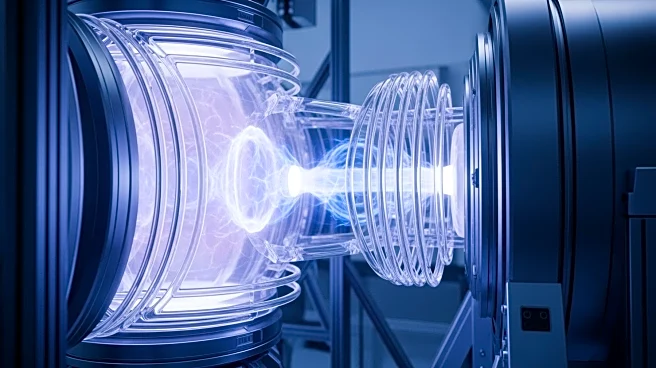
Thea Energy, a company based in Kearny, New Jersey, is making significant strides in the field of nuclear fusion with its innovative stellarator system architecture. The company, which originated from the Princeton Plasma Physics Laboratory, has developed a phased array control system that simplifies hardware and allows for dynamic tuning of system performance. This approach is designed to make fusion power plants easier and cheaper to build and operate. Thea Energy has achieved a milestone with the operation of the world's first superconducting planar coil magnet array, which is crucial for creating and controlling stellarator magnetic fields. The company is currently designing its first integrated fusion system, Eos, which will produce fusion neutrons
at scale. This development is part of Thea Energy's broader strategy to deploy fusion energy on the grid through its Helios power plant.
Why It's Important?
Thea Energy's advancements in fusion technology are significant as they promise a more practical and scalable approach to generating clean energy. Fusion energy has long been considered a potential solution to the world's energy needs due to its ability to produce large amounts of energy without the carbon emissions associated with fossil fuels. Thea Energy's technology could lead to more cost-effective and reliable fusion power plants, which would be a major breakthrough in the energy sector. This development could reduce reliance on traditional energy sources and help meet increasing global energy demands. The company's approach also addresses some of the traditional challenges of fusion technology, such as the complexity and precision required in hardware manufacturing, by using simpler, programmable magnets.
What's Next?
Thea Energy plans to operate its Eos system by 2030, with the goal of deploying the Helios power plant by 2035. The company is working to establish partnerships across the energy industry to accelerate the scaling of its fusion power plants. As the demand for clean and abundant energy continues to rise, Thea Energy's technology could play a crucial role in meeting these needs. The company is also focusing on building relationships with power offtakers and commercialization partners to facilitate the deployment of its technology. The success of Thea Energy's fusion systems could pave the way for widespread adoption of fusion energy, potentially transforming the global energy landscape.
Beyond the Headlines
Thea Energy's work in fusion technology not only has the potential to revolutionize the energy sector but also raises important considerations regarding the future of energy infrastructure. The company's approach to using mass-manufacturable components and software-based controls could lead to more sustainable and adaptable energy systems. Additionally, the development of fusion energy could have significant geopolitical implications, as countries seek to secure energy independence and reduce their carbon footprints. Thea Energy's advancements may also influence regulatory frameworks and policies related to energy production and distribution, as governments and industries adapt to new technologies and their potential impacts.