








What's Happening?
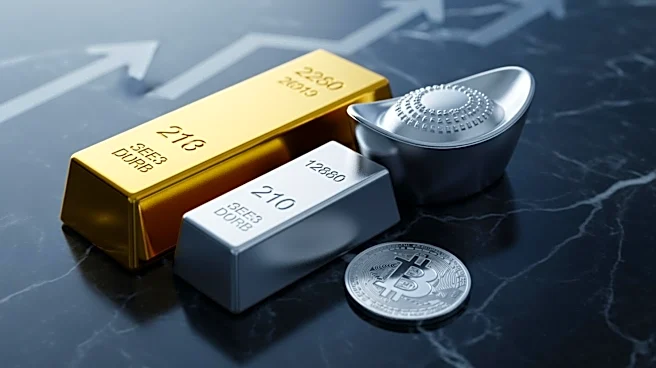
Gold prices have experienced a significant correction this year, dropping nearly 8% in less than a week. Despite this decline, market strategist Jeff Clark argues that gold remains within a historic bull market, drawing parallels to the 1970s bull market.
Clark notes a 95% correlation between the current market and the 1970s rally, suggesting that the current correction may be a normal part of a larger advance. Gold prices, which reached a record high of $5,600 an ounce in January, have turned negative for the year, with spot gold last trading at $4,125.50. The ongoing war in Iran and rising energy prices have contributed to inflation fears, prompting expectations of interest rate hikes by the Federal Reserve.
Why It's Important?
The current correction in gold prices is significant as it highlights the volatility and challenges facing the precious metals market. Investors and analysts are closely watching gold as a hedge against inflation and economic uncertainty. The potential for gold prices to triple, as suggested by Clark, could attract investors seeking long-term growth opportunities. However, the market faces headwinds from geopolitical tensions, rising energy prices, and potential interest rate hikes. These factors could influence investor sentiment and impact the broader financial markets, including equities and commodities.
What's Next?
If the correlation with the 1970s bull market holds, gold prices could see substantial growth in the coming years. Investors may view the current correction as a buying opportunity, with some, like Clark, aggressively adding to their positions. The Federal Reserve's monetary policy decisions, particularly regarding interest rates, will be crucial in shaping the market's direction. Additionally, geopolitical developments, such as the situation in Iran, and economic indicators, like inflation rates, will continue to influence gold prices and investor strategies.