







What's Happening?
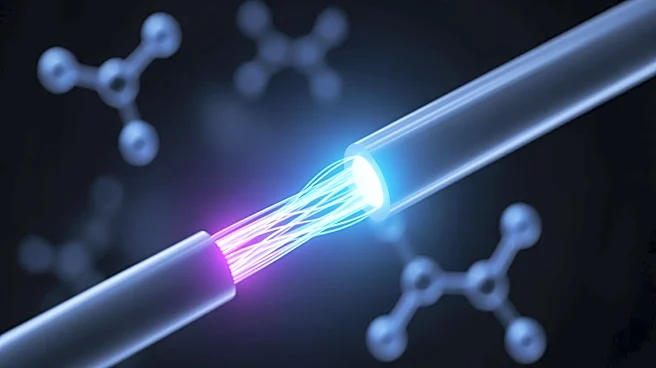
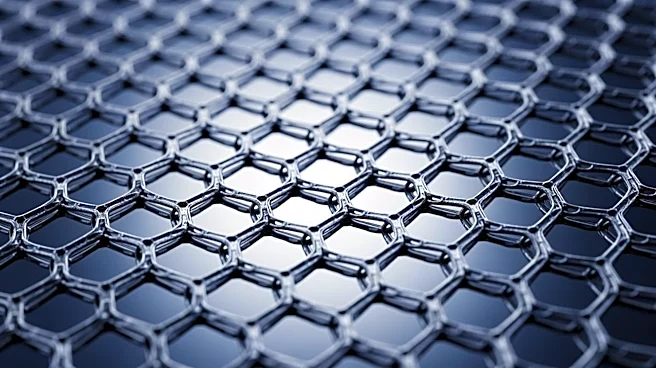
Recent developments in nano-architected chainmail material have focused on the creation of one-dimensional van der Waals (vdW) materials. These materials, characterized by their narrow structures, are being explored for their potential applications in nano-electronics
and optics. The preparation of single-chain one-dimensional materials has been achieved through both top-down and bottom-up approaches, such as mechanical exfoliation and ultrasound. These methods have led to the development of materials like PdGeS3, which are composed of covalently bonded chains held together by weak vdW interactions. The process involves electrochemical intercalation to achieve single chains, which are then evaluated using techniques like scanning tunneling microscopy and atomic force microscopy. These materials show promise for integrated photonic circuits, potentially replacing electronic circuits with faster and more efficient light-based systems.
Why It's Important?
The advancement of one-dimensional vdW materials is significant for the future of nano-electronics and optics. These materials offer the potential to revolutionize integrated photonic circuits, which could lead to faster and more efficient systems compared to traditional electronic circuits. The ability to create single-chain materials with high quality and stability opens up new possibilities for their use as molecular building blocks in fundamental physics and related applications. The development of these materials could impact various industries, including telecommunications and computing, by providing more efficient and scalable solutions. Additionally, the research into these materials contributes to the broader field of nanotechnology, pushing the boundaries of what is possible at the atomic scale.
What's Next?
Future research will likely focus on further refining the methods for producing single-chain one-dimensional materials and exploring their applications in various fields. The potential for these materials to be used in single-electron transistors and other quantum devices is an area of interest, as they offer unique electronic properties and quantum phenomena. Continued exploration of the intercalation chemistry and the development of new materials with similar properties could lead to breakthroughs in nano-electronics and optics. Researchers may also investigate the scalability of these materials for commercial applications, which could lead to significant advancements in technology and industry.
Beyond the Headlines
The development of one-dimensional vdW materials raises important questions about the ethical and environmental implications of nanotechnology. As these materials become more prevalent, considerations around their production, use, and disposal will need to be addressed. The potential for these materials to replace traditional electronic components also poses challenges for existing industries and could lead to shifts in the job market. Additionally, the use of these materials in quantum devices may have implications for data security and privacy, as they could enable new forms of computing and communication.