






What's Happening?
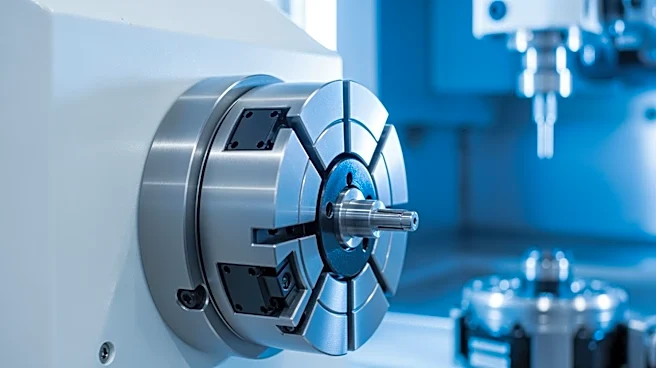
The global market for Rotary Tables with Torque Motor Drive is projected to experience sustained growth through 2035, according to a report by IndexBox. This growth is primarily driven by the increasing demand for high-precision manufacturing across advanced
industries such as aerospace, automotive, and semiconductors. Unlike traditional geared tables, torque motor drive systems offer superior accuracy and reliability, which are essential for modern multi-axis machining and complex component fabrication. The market is expected to bifurcate into high-volume segments for standardized applications and premium segments focused on ultra-precision solutions. The report highlights the transition towards smarter, more connected factories and the pursuit of manufacturing efficiency as key factors solidifying the position of torque motor rotary tables as a critical technology for industrial advancement.
Why It's Important?
The expansion of the Rotary Tables with Torque Motor Drive market is significant for several U.S. industries, including aerospace, automotive, and medical device manufacturing. These sectors require advanced components with tight tolerances and high precision, which torque motor drive systems can provide. The adoption of these systems is expected to enhance productivity and accuracy, reduce non-productive time, and enable unattended machining, which is crucial for cost-competitive mass production. As industries continue to demand lighter, more complex components and stringent quality standards, the role of torque motor rotary tables becomes increasingly vital. This growth also reflects broader trends in manufacturing efficiency and technological innovation, impacting economic stakeholders and potentially leading to increased investment in advanced manufacturing technologies.
What's Next?
The market is expected to see a compound annual growth rate in the mid-single digits, driven by the ongoing replacement and retrofit of older machine tools with newer systems integrating direct-drive technology. Demand will be cyclical, influenced by broader economic conditions affecting key end-use sectors like automotive and aerospace. However, underlying trends such as miniaturization in electronics and stringent quality standards in medical devices provide a resilient demand floor. The supply side will feature competition among specialized manufacturers and large industrial automation conglomerates, with pricing pressure in standardized segments and healthier margins in premium solutions. Regional dynamics will see Asia-Pacific leading as a major production hub, while North America and Europe maintain strong innovation and premium adoption rates.
Beyond the Headlines
The adoption of torque motor rotary tables reflects a broader shift towards Industry 4.0 and smart factory initiatives, demanding higher precision and data integration. This transition is not only about technological advancement but also involves ethical and cultural dimensions, such as the impact on workforce skills and the need for continuous training to handle complex systems. Additionally, the integration of these systems into manufacturing processes raises questions about data security and the management of digital information. As industries move towards more connected and automated environments, the implications for labor markets, regulatory frameworks, and global competitiveness become increasingly significant.