
What's Happening?
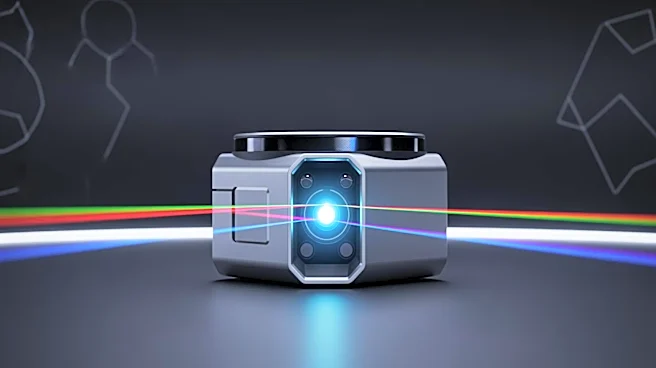
Ouster, a San Francisco-based lidar company, has announced a new lineup of lidar sensors called 'Rev8,' which feature 'native color lidar.' These sensors are designed to capture both color imagery and
three-dimensional depth information simultaneously, effectively combining the functions of a camera and a lidar sensor into one device. Ouster CEO Angus Pacala described this development as a significant advancement, aiming to eliminate the need for separate cameras in robotic systems. The Rev8 sensors are expected to streamline data processing by providing a pre-fused data stream, which could be particularly beneficial for robotics and autonomous vehicle applications. The announcement comes amid a period of consolidation in the lidar industry, with Ouster having recently acquired Velodyne and other companies like Luminar undergoing asset acquisitions.
Why It's Important?
The introduction of color lidar by Ouster could significantly impact the robotics and autonomous vehicle industries by simplifying sensor systems and reducing costs. By integrating color and depth sensing into a single device, companies can potentially streamline their hardware and software systems, leading to more efficient and cost-effective solutions. This innovation could also enhance the capabilities of autonomous systems, providing more accurate and reliable data for navigation and decision-making. As the market for sensors continues to grow, with companies like Waymo expanding their robotaxi services, Ouster's new technology could position it as a key player in the industry, offering a competitive edge over traditional camera and lidar setups.
What's Next?
Ouster has already begun shipping samples of the Rev8 sensors to existing customers and is now taking orders. The company anticipates that its new sensors will be adopted in various applications, including high-speed robo-trucking, robotaxi services, and drone operations. As the technology gains traction, it could lead to a shift in how autonomous systems are designed and implemented, potentially reducing reliance on traditional cameras. Additionally, Ouster's approach of integrating lidar and imaging technology on the same chip could set a new standard in the industry, prompting other companies to follow suit.