





What's Happening?
South Korean telecom operator LG Uplus is significantly expanding its AI data center infrastructure with a strategic investment of 5 trillion Korean won (approximately $3.26 billion) by 2030. The company aims to increase its annual sales by 15% to 20%
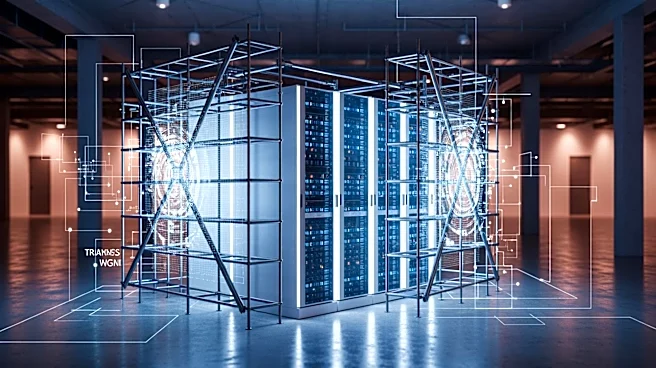
through this initiative. Central to this strategy is the construction of a 200MW hyperscale facility in Paju, Gyeonggi Province, which will serve as a key hub for inference-driven AI workloads. The facility, spanning 150,000 square meters, is designed to support high power levels and will be the only one of its kind in the Seoul metropolitan area. LG Uplus is adopting a prefabricated modular construction method to expedite the deployment of this data center, which will feature advanced cooling technologies co-developed with LG Electronics. The facility will also incorporate an AI-based data center infrastructure management system to ensure operational stability and efficiency.
Why It's Important?
The investment by LG Uplus in AI data centers is a significant move in the tech industry, highlighting the growing demand for infrastructure capable of supporting advanced AI operations. As AI workloads shift from training to inference, the need for efficient and powerful data centers becomes critical. This development is likely to influence the global data center market, pushing other companies to enhance their infrastructure to remain competitive. The focus on energy efficiency and advanced cooling technologies also underscores the industry's shift towards sustainable practices. This expansion could lead to increased innovation in AI applications, benefiting sectors such as telecommunications, finance, and healthcare, which rely heavily on AI-driven insights.
What's Next?
The first building of the Paju AI Data Center is scheduled for completion in June 2027, with all contracts for the space already signed. LG Uplus plans to transition from constructing data centers to becoming an AI factory operator, managing integrated systems for AI workloads. This shift will allow the company to optimize conditions for AI operations, potentially setting a new standard for data center management. The success of this project could prompt other telecom operators and tech companies to adopt similar strategies, further accelerating the development of AI infrastructure globally.