




What's Happening?
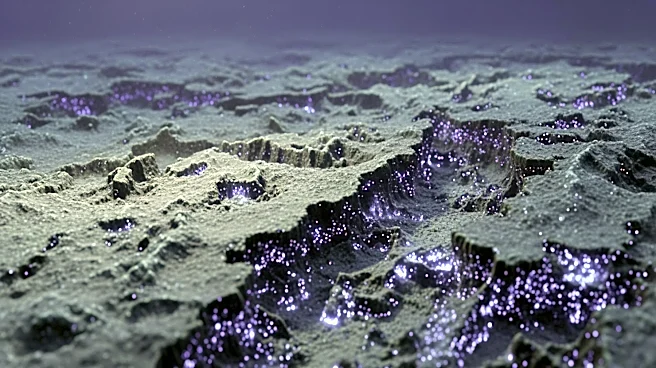
Deep Sea Minerals Corp. has made significant progress in its quest to explore critical minerals on the Pacific seabed. The National Oceanic and Atmospheric Administration (NOAA) has determined that the company's application under the Deep Seabed Hard
Mineral Resources Act (DSHMRA) meets the necessary requirements to proceed with federal review. This application, submitted by the company's U.S. subsidiary, American Ocean Minerals Corp., seeks an exploration license for a section of the Clarion-Clipperton Zone, a region rich in nickel, cobalt, copper, and manganese. The area could cover up to 150,000 square kilometers if fully approved. This development aligns with the Trump administration's efforts to secure domestic sources of critical minerals, crucial for various industries including defense and energy.
Why It's Important?
The advancement of Deep Sea Minerals' application is a pivotal step in the U.S. strategy to reduce reliance on foreign sources for critical minerals, particularly from China. These minerals are essential for manufacturing batteries, defense systems, and other advanced technologies. The move could bolster the U.S. economy by fostering a new industry and creating jobs. However, it also raises environmental concerns, as deep-sea mining could impact fragile ocean ecosystems. Balancing economic benefits with environmental protection will be a key challenge as the U.S. moves forward with seabed mining initiatives.
What's Next?
The application will undergo further federal review before NOAA can issue an exploration license. This process will likely involve environmental assessments and consultations with stakeholders. If approved, Deep Sea Minerals plans to list on the Nasdaq Capital Market to attract U.S. investors. The outcome of this application could set a precedent for future seabed mining projects, influencing regulatory frameworks and international collaborations.
Beyond the Headlines
The U.S. maintains its own licensing system for seabed mining due to its non-ratification of the U.N. Convention on the Law of the Sea. This independent approach allows the U.S. to pursue its interests but may complicate international relations and environmental governance. The ethical implications of exploiting ocean resources and the potential long-term environmental impacts will be critical considerations for policymakers and industry leaders.