






What's Happening?
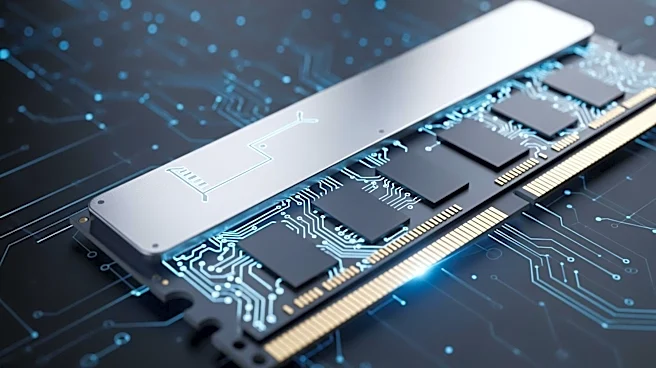
Rambus Inc., a leader in semiconductor technology, has announced the release of its DDR5 9600 Client Memory Module Chipset, designed to enhance performance in AI-driven PCs. This new chipset includes the Gen2 Client Clock Driver, PMIC5120, and SPD Hub,
offering breakthrough performance with support for memory module operation up to 9600 MT/s. The chipset is tailored for high-performance computing tasks, such as gaming and content creation, and supports advanced memory module form factors like CUDIMM and CSODIMM. Rambus aims to address the growing demand for higher memory bandwidth and capacity in AI-enabled PCs, providing a complete solution for clocked DDR5 modules.
Why It's Important?
The introduction of Rambus's DDR5 9600 Client Chipset is a significant development in the semiconductor industry, particularly for the U.S. market. As AI-driven workloads become more prevalent, the need for high-performance memory solutions is critical. This chipset addresses key challenges such as signal degradation and timing instability, enabling stable, high-speed operation. By enhancing memory bandwidth and capacity, Rambus's solution supports the growing demands of AI applications, potentially influencing the design and performance of future PCs. This advancement could drive innovation in sectors reliant on high-performance computing, such as gaming, content creation, and professional workstations.
What's Next?
Rambus's new chipset is expected to accelerate the adoption of next-generation AI PCs, as it provides the necessary infrastructure for high-performance computing. The company may continue to innovate and expand its product offerings to meet evolving industry needs. As AI applications become more integrated into everyday computing, the demand for advanced memory solutions is likely to increase, prompting further developments in semiconductor technology. Industry stakeholders, including PC manufacturers and tech companies, will likely explore partnerships with Rambus to leverage its cutting-edge technology. The success of this chipset could set new standards for memory performance in AI-driven devices.