
What's Happening?
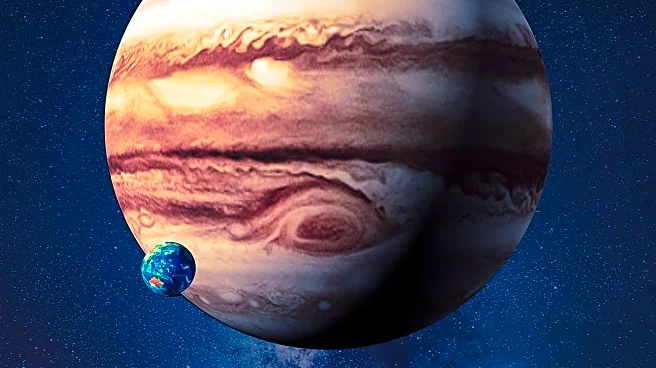
Jupiter is at opposition, meaning it is directly opposite the Sun as seen from Earth, making it particularly visible and bright in the night sky. This celestial event occurs as Jupiter rises at sunset
and remains visible all night, positioned in the constellation Gemini near the stars Pollux and Castor. The planet appears large, with a width of 47 arcseconds across its equator, and will maintain this size throughout January. The event provides an excellent opportunity for astronomers and stargazers to observe Jupiter's features, including its dark belts and bright zones. The last-quarter Moon is also visible near Spica, adding to the celestial display.
Why It's Important?
Jupiter's opposition is a significant event for both amateur and professional astronomers, as it offers a clear view of the planet's surface features and its moons. This alignment allows for detailed observations and photography, contributing to ongoing research and public interest in astronomy. The event also serves as an educational opportunity, encouraging people to engage with astronomy and learn more about the solar system. For the scientific community, such events can provide data that enhances understanding of planetary atmospheres and dynamics. The visibility of Jupiter and its moons can inspire interest in space exploration and science education.
What's Next?
Following Jupiter's opposition, astronomers and enthusiasts will continue to observe the planet as it remains prominent in the night sky throughout January. This period will allow for further study and documentation of Jupiter's atmospheric conditions and its interactions with its moons. As the year progresses, other celestial events will capture the attention of the astronomy community, including meteor showers and planetary alignments. These events will continue to provide opportunities for public engagement and scientific discovery, fostering a deeper appreciation for the wonders of the universe.