





What's Happening?
Seprify, a Swiss start-up co-founded by physicist Lukas Schertel and entrepreneur Oliver Polcher, is pioneering the use of cellulose to create sustainable alternatives to conventional ingredients like titanium dioxide (TiO2). The company, which originated
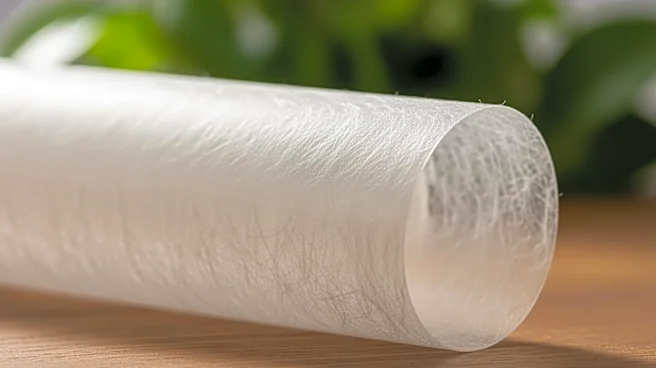
from research at the University of Cambridge, has developed a platform technology that transforms cellulose into microstructured particles. These particles are designed to control light interaction, achieving properties such as whiteness, opacity, and SPF boosting without relying on chemical compositions. This innovation is inspired by natural systems, such as the Cyphochilus beetle, which appears white due to its microscopic structure rather than pigments. Seprify's technology is applicable across various industries, including personal care, cosmetics, food, pet food, nutraceuticals, and coatings.
Why It's Important?
Seprify's innovation represents a significant advancement in sustainable materials, offering an eco-friendly alternative to widely used chemical ingredients. By utilizing cellulose, the most abundant natural polymer, the company addresses environmental concerns associated with traditional manufacturing processes. This development could lead to reduced reliance on non-renewable resources and decrease the environmental impact of industries such as cosmetics and food production. The ability to replicate natural light-scattering properties without chemical additives also opens new possibilities for product formulation, potentially enhancing product safety and consumer appeal. As industries increasingly prioritize sustainability, Seprify's technology could play a crucial role in driving eco-friendly practices and innovation.
What's Next?
Seprify is likely to continue expanding its applications across various sectors, leveraging its technology to meet the growing demand for sustainable products. The company's focus on cellulose-based solutions aligns with global trends towards reducing environmental footprints and enhancing product safety. As more industries adopt these sustainable alternatives, Seprify may explore partnerships and collaborations to scale its technology and integrate it into mainstream manufacturing processes. The success of this innovation could also inspire further research and development in bio-based materials, potentially leading to new breakthroughs in sustainable product design.
Beyond the Headlines
The development of cellulose-based alternatives by Seprify highlights a broader shift towards biomimicry in material science, where natural processes inspire technological advancements. This approach not only offers environmental benefits but also challenges traditional manufacturing paradigms by emphasizing structure over chemical composition. The success of such innovations could influence regulatory standards, encouraging industries to adopt more sustainable practices. Additionally, as consumers become more environmentally conscious, the demand for products with reduced ecological impact is likely to increase, driving further innovation and competition in the market.