


What's Happening?
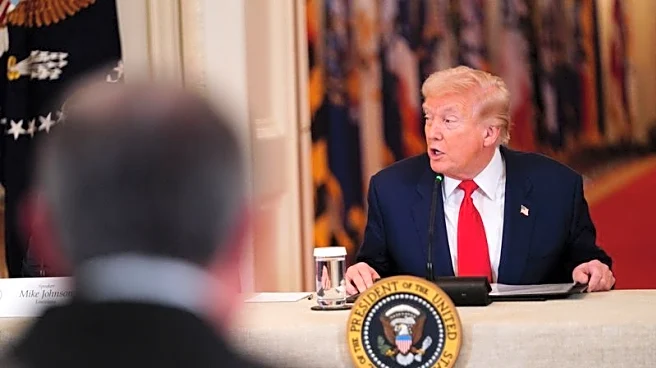
President Trump announced plans to sign an executive order concerning college sports during a roundtable discussion at the White House. The meeting included prominent figures such as Nick Saban, Tiger Woods, and Urban Meyer, and was overseen by Speaker
of the House Mike Johnson. The executive order aims to address issues in college sports, particularly those arising from the Name, Image, and Likeness (NIL) era. Trump indicated that the order would be more comprehensive than previous attempts and is intended to prevent the destruction of college sports. The SCORE Act, a legislative proposal to regulate college sports, has not advanced in Congress, prompting Trump to consider executive action. However, he acknowledged that the order might face legal challenges.
Why It's Important?
The executive order could significantly impact the structure and financial dynamics of college sports in the U.S. By potentially reverting to a pre-NIL system, the order may affect how athletes are compensated and how colleges manage their sports programs. This move could influence the balance between revenue-generating and non-revenue sports, affecting funding and opportunities for athletes. Stakeholders such as college administrators, athletes, and sports organizations may experience shifts in power and financial distribution. The legal challenges anticipated by Trump could lead to prolonged uncertainty and debate over the governance of college sports.
What's Next?
If the executive order is signed, it is likely to face immediate legal scrutiny, potentially leading to court battles that could delay its implementation. Stakeholders, including college sports administrators and legal experts, will closely monitor the situation to assess the order's implications. The outcome of these legal challenges could set precedents for future governance of college sports. Additionally, the response from Congress and other political leaders may influence the order's effectiveness and longevity.