



What's Happening?
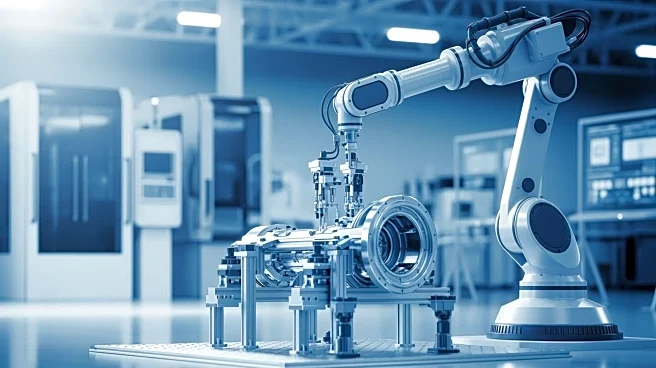
Machina Labs Inc. has successfully closed a $124 million Series C funding round to establish a large-scale intelligent factory in the United States. The Los Angeles-based company, founded in 2019, aims to revolutionize manufacturing with its RoboCraftsman platform, which integrates advanced robotics and AI-driven process controls. This new facility, spanning 200,000 square feet, will house up to 50 RoboCraftsman cells and is designed to produce complex metal structures for aerospace and defense sectors. The funding round saw participation from Woven Capital, Lockheed Martin Ventures, Balerion Space Ventures, and Strategic Development Fund. The factory will enable rapid production of structural assemblies, significantly reducing timelines from months
to days, and will support both U.S. government and commercial programs.
Why It's Important?
The establishment of Machina Labs' intelligent factory marks a significant advancement in the manufacturing sector, particularly for aerospace and defense industries. By leveraging AI and robotics, the company aims to overcome traditional manufacturing constraints, offering greater speed, precision, and scalability. This development is crucial as it addresses the strategic need for rapid production capabilities in defense systems, which are often limited by manufacturing speed rather than design. The factory's dual-use capability also supports commercial innovation, particularly in the automotive industry, where rapid customization and design freedom are increasingly demanded. This initiative not only enhances national security but also positions the U.S. as a leader in advanced manufacturing technologies.
What's Next?
Machina Labs plans to fully operationalize its intelligent factory, focusing on producing a wide range of complex metal structures without significant retooling. The company will continue to collaborate with defense primes and the U.S. Air Force on projects involving missile and hypersonic structures. Additionally, Machina Labs will work closely with Toyota to develop automotive panels, further expanding its commercial applications. The success of this factory could lead to further investments and expansions, potentially setting a new standard for manufacturing processes across various industries.