



What's Happening?
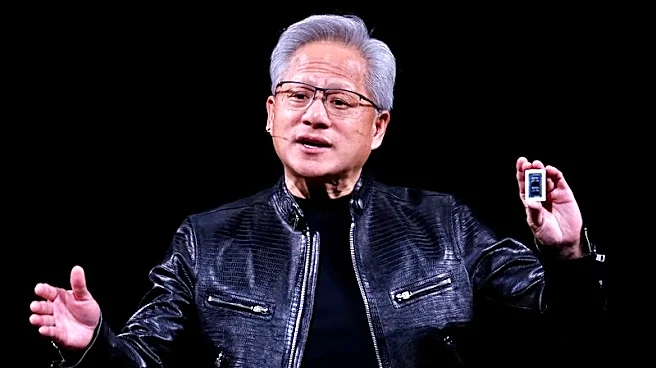
Nvidia and SK Hynix have announced a multiyear technology partnership aimed at advancing next-generation memory for AI factories. This collaboration is designed to support the global expansion of AI infrastructure by co-developing memory technologies
essential for AI computing platforms. The partnership builds on a history of collaboration between the two companies, focusing on semiconductor design and manufacturing. Nvidia's CEO, Jensen Huang, emphasized the importance of advanced memory in AI factories, which are seen as pivotal to the next industrial revolution. SK Hynix will leverage Nvidia's CUDA-X libraries and PhysicsNeMo framework to enhance semiconductor simulations and manufacturing processes. The partnership also includes the development of digital twins for autonomous fab operations, utilizing Nvidia's Omniverse and cuOpt technologies.
Why It's Important?
This partnership is significant as it addresses the growing demand for advanced memory solutions in AI infrastructure, which is crucial for the development of AI factories. By enhancing memory technology, Nvidia and SK Hynix aim to support the rapid expansion of AI capabilities globally. This collaboration not only strengthens Nvidia's position in the competitive semiconductor market but also allows SK Hynix to diversify into new AI markets. The development of digital twins and autonomous fab operations could lead to more efficient manufacturing processes, potentially reducing costs and increasing production capabilities. This partnership highlights the strategic importance of memory technology in the broader AI ecosystem, impacting industries reliant on AI advancements.
What's Next?
The partnership is expected to lead to the development of new memory technologies that will be integrated into Nvidia's AI computing platforms, including supercomputers and robotic computing systems. As AI factories continue to scale, the collaboration will ensure a stable supply of advanced memory, aligning with Nvidia's infrastructure roadmap. The companies will likely explore further applications of AI in semiconductor design and manufacturing, potentially leading to innovations in chip design and production efficiency. Stakeholders in the semiconductor and AI industries will be closely monitoring the outcomes of this partnership, as it could set new standards for memory technology in AI applications.