
What's Happening?
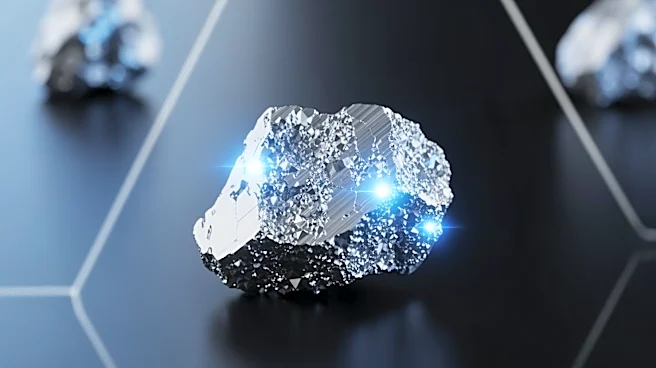
Researchers at UCLA, led by Professor Yongjie Hu, have developed a new metallic material, theta-phase tantalum nitride (θ-TaN), which sets a new benchmark for thermal conductivity among metals. This discovery,
published in the journal Science, could significantly impact heat management in electronics and other technologies. The material's thermal conductivity is measured at approximately 1,100 watts per meter-kelvin at room temperature, nearly three times that of copper, which has been the dominant material for thermal management due to its conductivity of about 400 watts per meter-kelvin. The superior performance of θ-TaN is attributed to its unique atomic structure, which minimizes phonon-electron interactions, allowing for more efficient heat transfer. The research team used advanced techniques, including high-resolution inelastic X-ray scattering, to confirm the material's properties.
Why It's Important?
The development of θ-TaN is crucial as it addresses the growing thermal management challenges posed by expanding artificial intelligence applications and data centers, which generate significant heat. Copper, traditionally used in chips and AI hardware, is reaching its performance limits in managing this heat. The new material could potentially replace or complement copper, offering a more efficient solution for heat dissipation. This advancement is not only significant for computing but also holds potential applications in aerospace systems and emerging quantum platforms. If θ-TaN can be produced at scale, it could revolutionize thermal management across multiple industries, providing a substantial impact on how heat is managed in various technological applications.
What's Next?
The practical application of θ-TaN depends largely on the ability to produce it at scale. The material is described as metastable, existing in a stable configuration under specific conditions, which presents an engineering challenge for mass production. Researchers and industry stakeholders will need to address these manufacturing challenges to fully realize the material's potential. Additionally, this discovery prompts a reevaluation of assumed limits in materials physics, suggesting that other long-standing constraints may also be revisable through precise measurement and theory. The ongoing research and development in this area could lead to further breakthroughs in thermal management materials.
Beyond the Headlines
The discovery of θ-TaN challenges the traditional understanding of thermal conductivity limits in metals, opening new avenues for research in materials science. This breakthrough suggests that other materials may also possess untapped potential for high thermal conductivity, which could lead to innovations in various fields beyond electronics, such as energy and transportation. The ability to manage heat more efficiently could lead to more sustainable and energy-efficient technologies, reducing the environmental impact of high-performance computing and other heat-intensive applications.