






What's Happening?
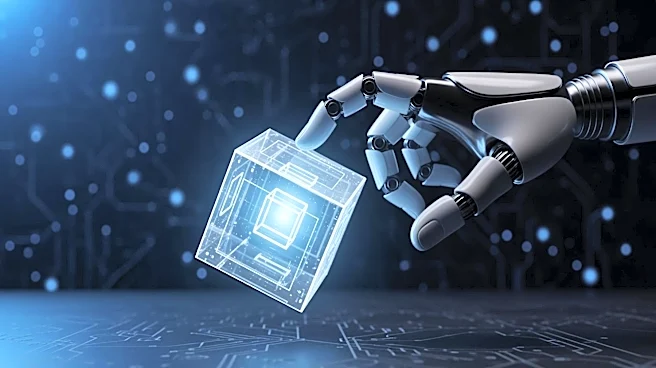
RLWRLD, a physical AI company, in collaboration with Nvidia, has launched an initiative to establish industry standards for humanoid robot AI. The initiative focuses on three main areas: DexBench, a universal benchmark for evaluating dexterity performance;
a data standard for dexterous manipulation training; and integration with Nvidia's Isaac Lab and Isaac Lab-Arena frameworks. The goal is to address the lack of a common framework for measuring and comparing humanoid dexterity performance, which has been a barrier to technology development and commercial deployment. RLWRLD's CEO, Junghee Ryu, emphasized the importance of a shared language for measuring robot hand movements to unlock the commercial potential of dexterity AI. Nvidia's Amit Goel highlighted the necessity of measurable and reproducible dexterous manipulation for scaling robotics adoption in industrial settings.
Why It's Important?
The development of standardized metrics and data infrastructure for humanoid robots is crucial for advancing the robotics industry. By providing a common yardstick for evaluating dexterity, DexBench aims to accelerate the development and deployment of reliable, high-precision robotic manipulation. This initiative could significantly impact industries reliant on precision tasks, such as assembly and packaging, by improving efficiency and reducing costs. The collaboration between RLWRLD and Nvidia could set a new benchmark for the global humanoid AI ecosystem, potentially leading to increased adoption of robotics in various sectors.
What's Next?
RLWRLD plans to continue expanding its global presence with a series of events under the 'Dexterity Night' banner, showcasing its RLDX-1 model's capabilities. Following successful events in San Francisco and Japan, the company will host an event in Seoul. These events aim to engage the global robotics community and demonstrate the potential of standardized dexterity metrics. As the industry adopts these standards, further collaborations and innovations in humanoid robotics are expected, potentially leading to new applications and markets.