







What's Happening?
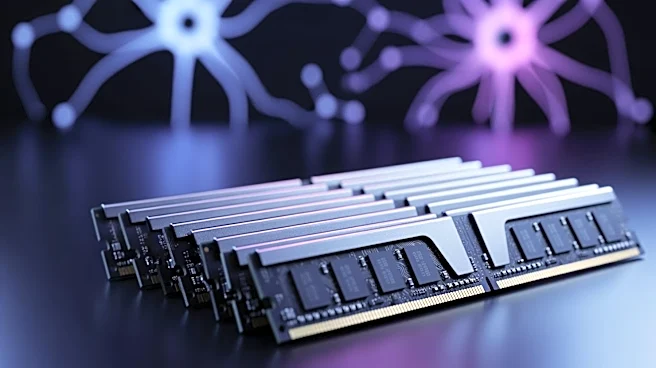
The cost of RAM for gaming PCs has significantly increased due to the growing demand from AI infrastructure developments. Companies like Google, Microsoft, and Amazon are investing heavily in high-bandwidth memory (HBM) for AI models, leading to a scarcity
of consumer RAM. As a result, prices for high-capacity RAM modules have tripled or quadrupled. This shift has forced gamers to adapt by considering single-channel memory configurations, which were previously avoided due to performance concerns. However, advancements in CPU cache technology have minimized the performance gap between single and dual-channel memory setups.
Why It's Important?
The rising cost of RAM poses a challenge for gamers and PC builders, as it increases the overall cost of building or upgrading gaming systems. This trend reflects broader economic shifts driven by the AI industry's demand for specialized memory, impacting consumer markets. The adaptation to single-channel memory configurations highlights the evolving landscape of PC gaming technology, where traditional norms are being reconsidered in response to market pressures. This situation underscores the interconnectedness of technological advancements and market dynamics, affecting both consumers and manufacturers.
What's Next?
As RAM prices continue to rise, gamers and PC builders may increasingly adopt single-channel configurations or explore alternative solutions to manage costs. The industry may also see further innovations in CPU and memory technologies to address these challenges. Additionally, the ongoing demand for AI infrastructure is likely to influence memory manufacturing priorities, potentially leading to long-term shifts in the availability and pricing of consumer RAM.