



What's Happening?
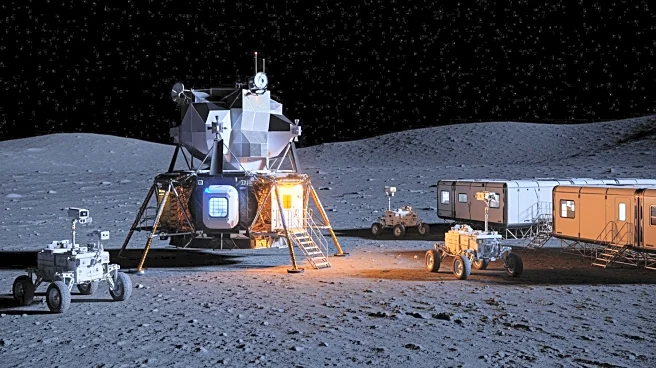
Elon Musk, the CEO of SpaceX, has announced a strategic shift in the company's focus from Mars colonization to establishing a 'self-growing city' on the Moon. This decision is driven by the logistical advantages the Moon offers, such as its proximity to Earth, which allows for more frequent launches and quicker development cycles. The Moon's shorter travel time and more frequent launch opportunities make it a more feasible target for near-term human settlement. SpaceX aims to leverage these advantages to rapidly iterate and develop sustainable technologies for lunar colonization. This pivot aligns with SpaceX's capabilities and accelerates timelines for lunar exploration, promising quicker returns on investment through established space markets.
While Mars remains a long-term goal, the immediate priority is to address near-term opportunities on the Moon.
Why It's Important?
The shift in focus from Mars to the Moon by SpaceX represents a significant recalibration in the company's strategy, emphasizing practicality and feasibility. The Moon's proximity allows for more rapid iteration in colony building, which is crucial for developing sustainable bases equipped with self-replicating infrastructure. This move not only aligns with SpaceX's capabilities but also positions the company to capitalize on the growing interest in lunar exploration. The competition in space exploration is intensifying, with companies like Blue Origin also vying for contracts and prestige in the next phase of human space exploration. SpaceX's progress in lunar development could significantly impact the future of space exploration, where commercial entities play significant roles alongside government agencies like NASA.
What's Next?
SpaceX's focus on lunar projects is expected to accelerate the development of sustainable technologies for lunar colonization. The company's efforts will likely involve frequent launches to the Moon, enabling rapid iteration and development of infrastructure. This strategic pivot could also influence NASA's Artemis program, which aims to return astronauts to the Moon by 2026. As SpaceX and other private companies compete for NASA contracts, their progress and achievements could usher in a new era of space exploration. The success of these initiatives could pave the way for future extraterrestrial colonization efforts, with the Moon serving as a testing ground for technologies that could eventually be used on Mars.
Beyond the Headlines
The decision to prioritize the Moon over Mars highlights the practical challenges of long-term space missions. The Moon's logistical advantages make it an ideal testing ground for sustainable technologies that could eventually be used for Mars colonization. This shift also underscores the growing role of private companies in space exploration, as they compete for government contracts and drive technological innovation. The rivalry between SpaceX and Blue Origin, for instance, could lead to significant advancements in space technology and infrastructure. As commercial entities take on more prominent roles in space exploration, the dynamics of the industry are likely to change, with private companies playing a crucial role in shaping the future of human space exploration.