



What's Happening?
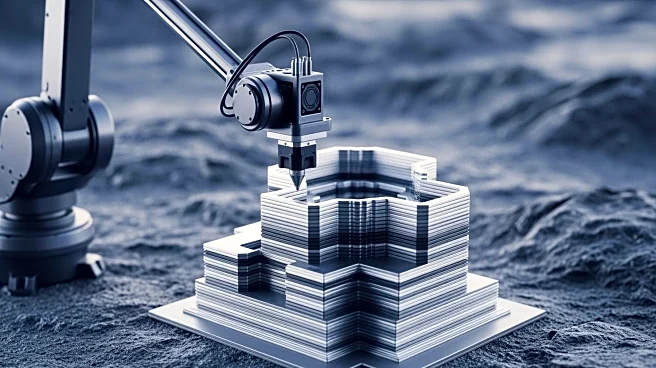
Recent research published in npj Space Exploration highlights the potential of robotic prefabrication and three-dimensional (3D) printing to transform construction practices in extreme environments, including potential future habitats on Mars. The study
explores how these technologies can enhance building efficiency, reduce material waste, and support the development of resilient structures in harsh terrestrial and extraterrestrial settings. By utilizing automated systems and additive manufacturing processes, these methods allow for the precise production of building components, minimizing labor and material requirements. The research also emphasizes the potential for in-situ resource utilization (ISRU) on Mars, where local materials like Martian regolith could be processed into structural components, reducing the need for transporting materials from Earth.
Why It's Important?
The integration of robotic prefabrication and 3D printing in construction could significantly impact both terrestrial and extraterrestrial building practices. On Earth, these technologies offer a sustainable approach to construction, particularly in remote or resource-constrained environments such as Arctic regions and deserts. By reducing material waste and labor demands, they present a cost-effective solution for infrastructure development. In space exploration, the ability to use local materials for construction on Mars could be crucial for establishing durable habitats, supporting long-term human missions. The study also highlights the growing global investment in automated construction technologies, indicating a shift towards more sustainable and efficient building practices.
What's Next?
Future research is expected to focus on enhancing automated construction systems, developing new printable materials, and integrating essential habitat systems like radiation protection and life-support technologies. The study suggests that interdisciplinary collaboration across fields such as robotics, materials science, and architecture will be vital for advancing extraterrestrial construction capabilities. As these technologies continue to evolve, they could play a pivotal role in disaster relief operations and rapid infrastructure deployment in remote areas on Earth.
Beyond the Headlines
The study underscores the need for a holistic approach to construction in extreme environments, balancing architectural complexity with environmental performance. It reveals that while prefabrication offers significant carbon efficiency benefits, these advantages vary based on local conditions and construction practices. The research also points to the fragmentation across key research disciplines, suggesting that integrated efforts are necessary to fully realize the potential of automated construction technologies for both Earth and space applications.