



What's Happening?
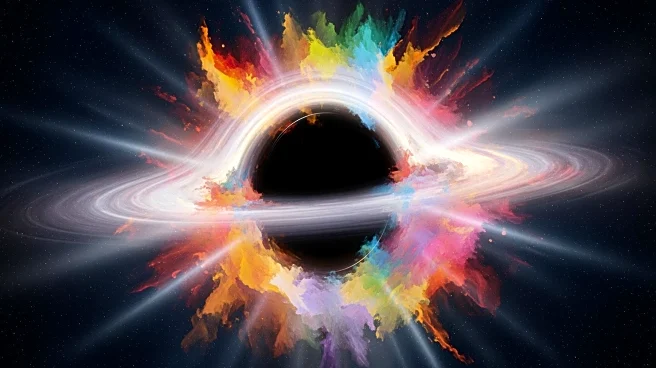
A new art exhibition titled 'Conjuring the Void: The Art of Black Holes' is showcasing a wide array of artworks inspired by the enigmatic nature of black holes. The exhibition features various mediums, including charcoal sketches, pen-and-ink drawings, oil and acrylic paintings, murals, sculptures, and digital photography. The project was inspired by a talk given by Lynn Gamwell, a former director of the New York Academy of Science’s Gallery of Art and Science, at Harvard’s Black Hole Initiative. Gamwell, who has a background in the intersection of math, art, and science, was intrigued by the abundance of art inspired by black holes, particularly in Asian art. The exhibition includes works that reflect themes resonant with Eastern philosophies
such as Buddhism and Taoism, which align with the scientific concepts of void and nothingness associated with black holes.
Why It's Important?
The exhibition highlights the intersection of science and art, demonstrating how scientific phenomena like black holes can inspire creative expression across cultures. This fusion of disciplines can enhance public understanding and appreciation of complex scientific concepts, making them more accessible and engaging. By showcasing art that draws from both Western scientific advancements and Eastern philosophical traditions, the exhibition fosters a cross-cultural dialogue. It underscores the universal fascination with black holes and their ability to transcend cultural boundaries, potentially inspiring future collaborations between scientists and artists.
What's Next?
The exhibition may lead to further interdisciplinary collaborations and inspire new artistic interpretations of scientific phenomena. As public interest in space and astrophysics grows, similar exhibitions could emerge, exploring other cosmic phenomena. Additionally, the exhibition could encourage educational institutions to incorporate art into science curricula, promoting a holistic approach to learning. The success of 'Conjuring the Void' might also prompt other galleries and museums to explore the relationship between art and science, potentially leading to a broader appreciation of both fields.