






What's Happening?
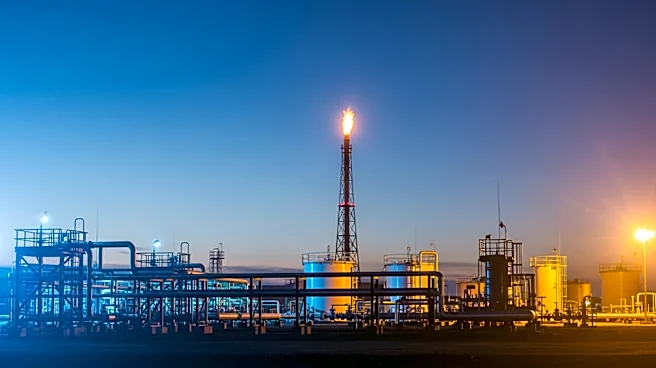
The Williston Basin, a significant petroleum system in North America, has transitioned from a high-growth oil production area to a stable, gas-heavy production system. Historically known for its oil output, the basin has seen a rise in gas production,
now exceeding 3.5 billion cubic feet per day. This shift is attributed to the maturity of wells and evolving completion designs. The basin's production profile is now characterized by a stable plateau, with oil production stabilizing at approximately 1.1 to 1.3 million barrels per day. The focus has shifted from exploration to optimizing recovery efficiency and capital allocation. The basin's infrastructure, particularly for gas, remains reactive, with expansions following production growth rather than leading it. Despite the high-quality crude produced, the basin faces logistical challenges due to its landlocked geography, resulting in a persistent discount in crude prices.
Why It's Important?
The Williston Basin's evolution reflects broader trends in the U.S. energy sector, where mature fields are increasingly focusing on efficiency and capital discipline over expansion. This shift has implications for investors and operators, as the basin is now viewed as a stable, cash-generating asset rather than a growth opportunity. The emphasis on gas production and infrastructure development highlights the changing dynamics in energy production, where natural gas is becoming a more significant component. The basin's logistical challenges underscore the importance of infrastructure in determining market access and pricing. As the basin continues to operate as a stable production hub, it plays a crucial role in the U.S. energy supply chain, feeding into established refining centers.
What's Next?
Future developments in the Williston Basin will likely focus on enhancing recovery efficiency and optimizing existing wells. The potential for redevelopment through refracturing and enhanced oil recovery methods presents opportunities for incremental production gains. However, achieving significant improvements in recovery factors will require sustained investment and technological advancements. The basin's ability to adapt to these challenges will determine its long-term contribution to U.S. energy supply. Additionally, infrastructure expansions, particularly for gas, will be critical in addressing periodic constraints and ensuring efficient market access.
Beyond the Headlines
The Williston Basin's transition highlights the broader economic and logistical challenges faced by landlocked production systems. The persistent discount in crude prices due to transportation costs emphasizes the need for strategic infrastructure investments. The basin's focus on capital discipline and shareholder returns reflects a shift in investor priorities, where efficiency and execution are valued over expansion. This trend may influence other mature fields in the U.S., as operators seek to maximize value in a competitive global energy market.