






What's Happening?
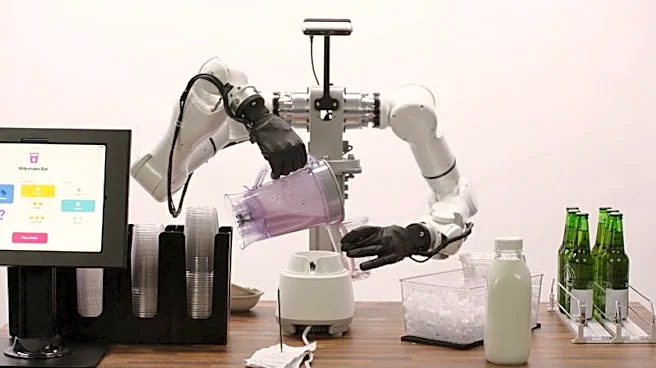
Rhoda AI, a Palo Alto-based company, has emerged from stealth mode with a groundbreaking approach to robotics data collection. Co-founder and chief scientist Eric Chan discussed the company's use of a direct video action (DVA) model on The Robot Report
Podcast. This model leverages internet video data to train intelligent robots, allowing them to perform complex tasks with minimal training. The DVA model addresses the challenge of data scarcity in robotics, enabling robots to learn from video and operate effectively in real-world environments. Rhoda AI's approach is poised to revolutionize how physical AI systems are developed and deployed.
Why It's Important?
The introduction of Rhoda AI's DVA model is significant for the robotics industry, particularly in the context of AI training. Traditional data collection methods in robotics often require extensive and costly datasets, which can be a barrier to innovation. By utilizing video data from the internet, Rhoda AI's model reduces the need for large, curated datasets, potentially lowering costs and accelerating development timelines. This innovation could lead to more efficient and adaptable robots, benefiting industries such as manufacturing, logistics, and healthcare. Companies that can quickly adapt to this new model may gain a competitive edge in the rapidly evolving AI landscape.
What's Next?
As Rhoda AI continues to develop its DVA model, the company may seek partnerships with other tech firms and industries to expand the application of its technology. The success of this model could prompt other AI and robotics companies to explore similar data collection methods, potentially leading to a shift in industry standards. Additionally, Rhoda AI's approach may attract interest from investors looking to support innovative AI solutions. The company's progress will likely be closely monitored by stakeholders in the tech and robotics sectors, eager to see how this new model performs in various applications.