







What's Happening?
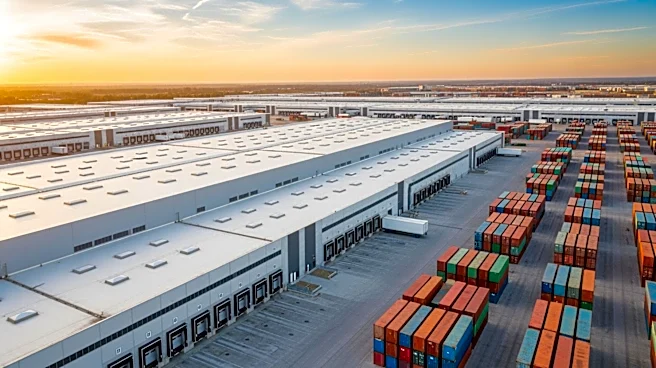
Prologis, a San Francisco-based real estate investment trust, has reported a positive outlook for the logistics real estate market, as indicated by their latest Industrial Business Indicator (IBI). The April IBI Activity Index recorded a reading of 58.6,
suggesting increased warehouse activity. This growth is attributed to sustained demand from advanced manufacturers and a rebound in retail and services. The logistics market is experiencing a critical inflection point, with demand for logistics space strengthening while new supply is at its lowest in a decade. This imbalance is expected to tighten vacancy levels and increase competition for prime assets. Prologis notes that logistics absorption space is improving, with expectations to reach 200 million square feet, although new deliveries are projected to be around 190 million square feet, the lowest in a decade.
Why It's Important?
The tightening supply and increased demand in the logistics real estate market have significant implications for U.S. industries, particularly those reliant on warehousing and distribution. As vacancy levels decrease and competition for space intensifies, companies may face higher costs and challenges in securing logistics space. This could impact supply chain efficiency and operational costs for businesses across various sectors. The shift towards automation and the growth of e-commerce and essential goods companies further underscore the evolving landscape of logistics real estate. The market dynamics could lead to increased rent growth and a new cycle of investment in logistics infrastructure.
What's Next?
As the logistics real estate market continues to evolve, companies are advised to act swiftly to secure space amid tightening supply. Prologis suggests that speed is crucial for occupiers looking to secure logistics space, as speculative space under construction is limited and vacancies are declining. The market is entering the early stages of a new rent growth cycle, with potential upward pressure on construction costs. Companies may need to adapt their strategies to navigate these changes, potentially leading to increased investment in logistics infrastructure and technology to enhance efficiency and competitiveness.