



What's Happening?
The Agriculture Technology-as-a-Service (AgTaaS) market is projected to grow significantly, reaching $18.13 billion by 2033, according to a report by DataM Intelligence. This growth is driven by the increasing adoption of digital farming solutions aimed
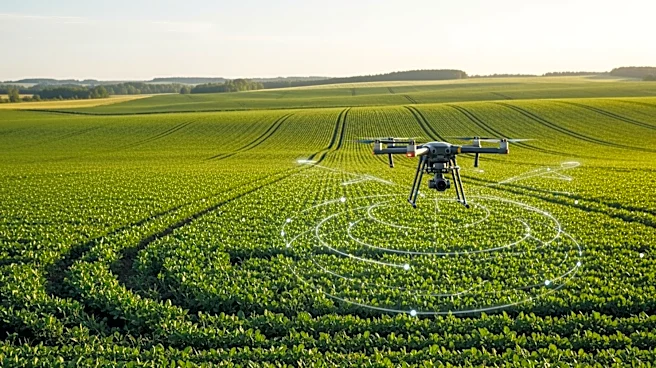
at enhancing productivity and reducing operational costs. The market is seeing a rise in the use of precision agriculture tools such as IoT sensors, drones, and data analytics platforms. Subscription-based service models are enabling farmers to access advanced technologies without high upfront investments. The report highlights the role of AI and machine learning in improving crop monitoring and yield prediction, as well as the expansion of cloud-based platforms for real-time decision-making. Key players in the market include 365FarmNet GmbH, AGCO Corporation, and IBM Corporation.
Why It's Important?
The expansion of the AgTaaS market is significant for the agricultural sector as it represents a shift towards more efficient and sustainable farming practices. By leveraging technology, farmers can optimize resource use, reduce waste, and increase crop yields, which is crucial in the face of growing global food demand. The integration of AI and machine learning in agriculture can lead to more precise farming techniques, reducing the environmental impact and improving food security. Additionally, the subscription-based model lowers the barrier to entry for small and medium-sized farms, allowing them to compete with larger operations. This democratization of technology could lead to more equitable growth in the agricultural sector.
What's Next?
As the AgTaaS market continues to grow, further innovations and collaborations between agri-tech startups and traditional farming enterprises are expected. The ongoing development of AI and machine learning applications will likely lead to more sophisticated tools for crop management and yield optimization. Government initiatives promoting smart agriculture are also anticipated to accelerate market expansion. Stakeholders in the agricultural industry will need to adapt to these technological advancements to remain competitive. The focus will likely be on enhancing the integration of these technologies into existing farming practices and ensuring that farmers are equipped with the necessary skills and knowledge to utilize them effectively.