



What's Happening?
The global Controlled Environment Agriculture (CEA) market is projected to grow significantly, reaching an estimated value of $271.01 billion by 2032, with a compound annual growth rate (CAGR) of 15.23% from 2025 to 2032. This growth is driven by increasing food demand, urbanization, climate change impacts, and the need for year-round crop production. Technological advancements in hydroponics, aeroponics, LED lighting, and automation are enhancing productivity and resource efficiency. North America currently dominates the CEA market with a 37% share, supported by advanced agri-tech infrastructure and strong consumer demand for locally grown produce. Europe follows with a 32% share, driven by sustainability regulations and urban farming initiatives.
Why It's Important?
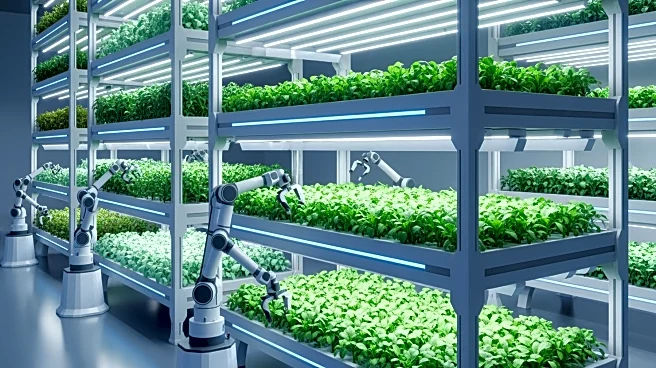
The expansion of the CEA market is crucial for addressing global food security challenges, particularly in urban areas where space for traditional agriculture is limited. By utilizing technologies such as hydroponics and vertical farming, CEA systems can produce higher yields with significantly less water compared to conventional farming methods. This is particularly important in regions facing water scarcity. Additionally, the integration of AI and automation in CEA operations can lead to more efficient resource use and reduced labor costs, making it a sustainable solution for future food production. The growth of this market also presents significant opportunities for businesses involved in agricultural technology and infrastructure development.
What's Next?
As the CEA market continues to expand, further investments in automation and precision farming technologies are expected. Governments may increase support for CEA initiatives through subsidies and policy incentives, particularly in regions with limited arable land. The development of new technologies and systems for CEA will likely continue, with a focus on improving efficiency and reducing costs. Companies involved in the CEA market may pursue mergers and acquisitions to enhance their capabilities and market reach. Additionally, there may be increased collaboration between industry, academia, and communities to advance CEA technologies and workforce development.