

What's Happening?
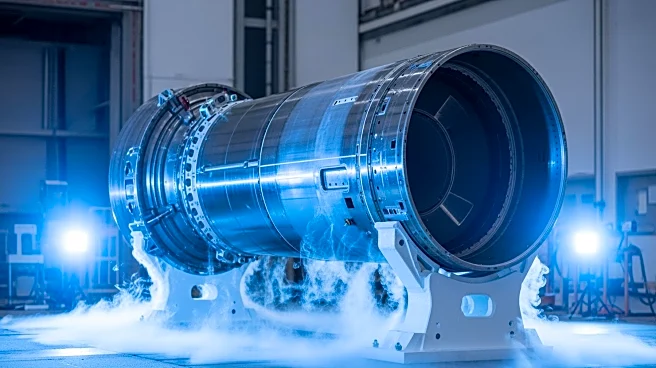
SpaceX has successfully completed cryogenic proof testing on its upgraded Super Heavy booster, a critical step for the next Starship flight. The testing involved subjecting the booster to multiple thermal and pressurization cycles using liquid nitrogen, simulating the conditions it will face during launch. This milestone follows a previous failure where a booster was destroyed during a pressure test. The successful completion of these tests marks progress towards launching the first test flight of the Starship V3, which features enhanced Raptor engines designed for greater thrust and reliability.
Why It's Important?
The successful testing of the Super Heavy booster is a significant advancement for SpaceX's Starship program, which aims to revolutionize space travel
with reusable rockets capable of carrying large payloads to the Moon, Mars, and beyond. This development is crucial for SpaceX's long-term goals of reducing space travel costs and increasing accessibility. The advancements in the Raptor engines and the booster design also reflect SpaceX's commitment to innovation and safety in aerospace engineering. The progress in the Starship program has implications for the future of commercial space exploration and potential collaborations with NASA and other space agencies.
What's Next?
Following the successful cryogenic tests, the Super Heavy booster will be equipped with 33 Raptor engines and grid fins before being transported to the launch pad for a test-firing. Concurrently, the first upgraded Starship vehicle will undergo its own series of tests, including a static fire test of its six Raptor engines. These steps are part of the preparation for the upcoming Starship V3 test flight, which will further demonstrate the capabilities of SpaceX's next-generation spacecraft.