



What's Happening?
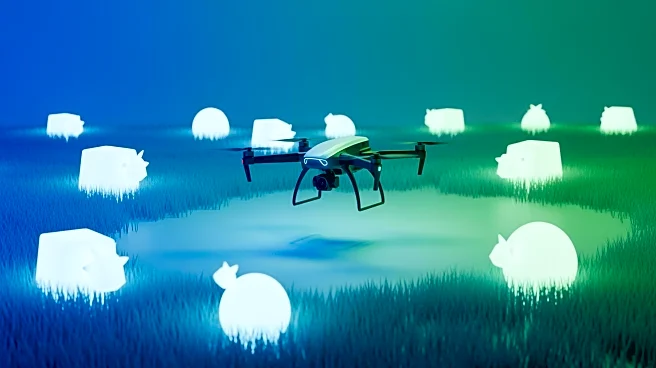
Drone-Hand, an agtech company founded by Edward Barraclough, is revolutionizing livestock management through the use of AI-powered drones. The company aims to address the challenges of monitoring livestock on vast properties, which can span up to a million acres. By teaming up with AI/ML engineer Dr. Sebastian Haan, Drone-Hand has developed autonomous systems that reduce labor costs and prevent livestock mortality by performing routine tasks such as stock checks, water inspections, and infrastructure monitoring. The drones are designed to operate offline, making them suitable for remote environments with limited connectivity. The technology is currently being tested in various countries, including the U.S., and has garnered interest from major
corporations like JBS Australia.
Why It's Important?
The introduction of AI-powered drones in livestock management represents a significant advancement in agricultural technology. By reducing labor costs and improving the efficiency of livestock monitoring, Drone-Hand's technology has the potential to increase profitability for farmers. This is particularly important in regions where labor shortages and high operational costs are prevalent. Additionally, the ability to prevent livestock mortality through timely interventions can lead to substantial savings for the industry. The adoption of such technology could also pave the way for more sustainable farming practices by optimizing resource use and reducing the environmental impact of traditional livestock management methods.
What's Next?
Drone-Hand is focused on ramping up commercialization and increasing revenue by expanding its user base and refining its technology. The company plans to open an assembly and maintenance hub in Darwin, Australia, to facilitate the production and distribution of its drones. As the technology gains traction, it is likely to attract more partnerships with large agricultural corporations and potentially disrupt traditional livestock management practices. The company is also exploring opportunities to integrate its technology with existing systems used by farmers, which could further enhance its appeal and adoption.