







What's Happening?
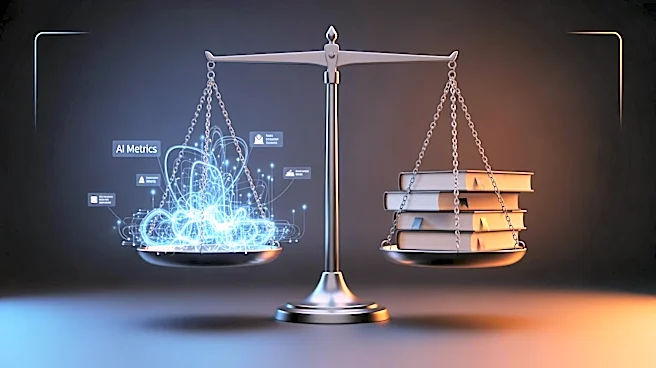
Recent AI benchmarks have concluded that AI cannot perform accounting tasks effectively, such as calculating tax returns or completing end-to-end workflows. However, these benchmarks are criticized for not reflecting the actual deployment of AI in accounting firms.
In practice, AI is used to assist in the initial stages of tax preparation, with human oversight ensuring accuracy. The benchmarks often evaluate AI models in isolation, without considering the iterative and collaborative nature of accounting processes. This has led to a misalignment between benchmark results and the practical application of AI in accounting, where AI serves as a tool to enhance efficiency rather than replace human judgment.
Why It's Important?
The discrepancy between AI benchmarks and real-world applications highlights the need for a more nuanced understanding of AI's role in accounting. While AI can streamline certain tasks, it is not yet capable of fully automating complex accounting processes. This understanding is crucial for accounting firms considering AI adoption, as it emphasizes the importance of integrating AI with existing workflows rather than relying on it for complete automation. The conversation around AI in accounting is evolving, with firms recognizing the potential for AI to improve efficiency and accuracy when used as part of a broader, human-centered approach.
Beyond the Headlines
The debate over AI's capabilities in accounting raises broader questions about the future of work and the role of technology in professional services. As AI continues to develop, it is likely to transform how accounting tasks are performed, potentially leading to shifts in job roles and required skill sets. This transformation necessitates ongoing dialogue between technology developers, accounting professionals, and policymakers to ensure that AI is implemented in ways that enhance, rather than disrupt, the industry. The focus should be on leveraging AI to complement human expertise, fostering a collaborative environment that maximizes the strengths of both technology and human judgment.