


What's Happening?
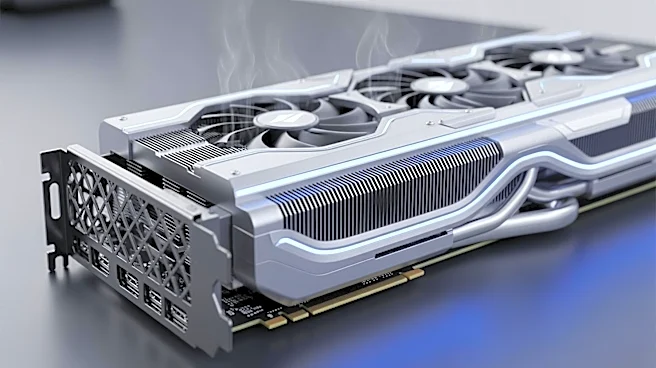
AORUS Taiwan has released detailed information about its new RTX 5090 Infinity graphics card, highlighting its advanced cooling system and performance capabilities. The card features a 3.5-slot cooler design with two large visible fans and a hidden third
fan that activates under heavy GPU load. This cooling system, known as WINDFORCE HYPERBURST, is designed to improve air pressure and airflow significantly. During a FurMark2 stress test, the card maintained a maximum GPU temperature of 77°C, with memory temperatures at 72°C. The card is built on an NVIDIA Founders Edition PCB and includes three DisplayPort 2.1b ports and one HDMI 2.1b connector. It requires a 1000W power supply and supports a boost clock of 2730 MHz, significantly higher than the reference card's 2407 MHz.
Why It's Important?
The introduction of the RTX 5090 Infinity graphics card by AORUS represents a significant advancement in graphics technology, particularly in cooling efficiency. This development is crucial for gamers and professionals who require high-performance graphics solutions that can handle intensive tasks without overheating. The enhanced cooling system ensures that the card can maintain optimal performance even under heavy loads, which is essential for applications such as gaming, video editing, and 3D rendering. Additionally, the card's high boost clock and large memory capacity make it a competitive option in the high-end graphics card market, potentially influencing pricing and technology standards across the industry.
What's Next?
As the RTX 5090 Infinity enters the market, it is likely to face competition from other high-end graphics cards, prompting further innovations in cooling technology and performance enhancements. Consumers and industry analysts will be watching closely to see how the card performs in real-world applications and whether it meets the expectations set by its specifications. The pricing of the card, which has not yet been announced, will also play a critical role in its market reception. Additionally, other manufacturers may respond with their own advancements, leading to a competitive push for more efficient and powerful graphics solutions.