
What's Happening?
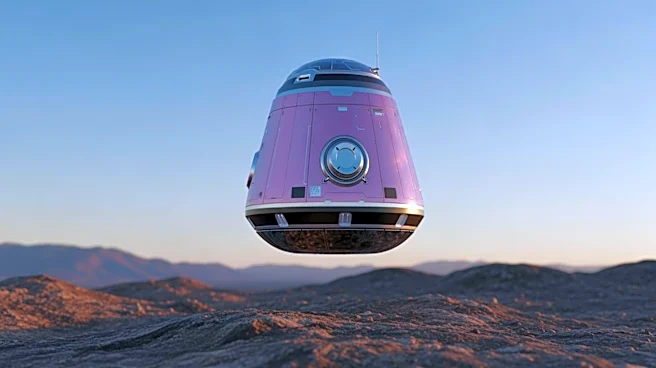
The Exploration Company has successfully completed a drop test of its Nyx spacecraft, which is being developed to transport cargo to low Earth orbit. The test took place on May 19 in California's Mojave
Desert, where a helicopter released a model of the capsule, known as the Drop Test Vehicle (DTV), from an altitude of 2,800 meters. The capsule deployed two drogue parachutes for stabilization, followed by four main parachutes, allowing it to land safely on the desert floor. This test is part of a broader qualification campaign for the Nyx's parachute system, which is crucial for its planned splashdown capabilities. The company is preparing for a 2028 orbital flight test that will include docking with the International Space Station. The European Space Agency (ESA) has selected The Exploration Company for the first phase of a cargo vehicle development program, modeled after NASA's commercial cargo services program.
Why It's Important?
The successful drop test of the Nyx capsule marks a significant milestone in The Exploration Company's efforts to develop a reliable spacecraft for cargo transport to low Earth orbit. This development is crucial for the future of commercial space operations, as it aligns with global efforts to enhance space logistics and infrastructure. The involvement of the European Space Agency and the potential for docking with the International Space Station highlight the international collaboration and interest in expanding commercial space capabilities. The success of such projects could lead to increased opportunities for private companies in the space industry, potentially reducing costs and increasing access to space for various stakeholders.
What's Next?
The Exploration Company plans to continue its development and testing of the Nyx spacecraft, with a focus on preparing for the 2028 orbital flight test. This test will include docking with the International Space Station, a critical step in demonstrating the spacecraft's capabilities. Additionally, the company is seeking to raise $200 million in funding to support its rocket engine projects, which include the development of engines for future lunar landers and cislunar spacecraft. The company's ongoing efforts to innovate in space transportation and logistics could lead to further advancements in the commercial space sector.