



What's Happening?
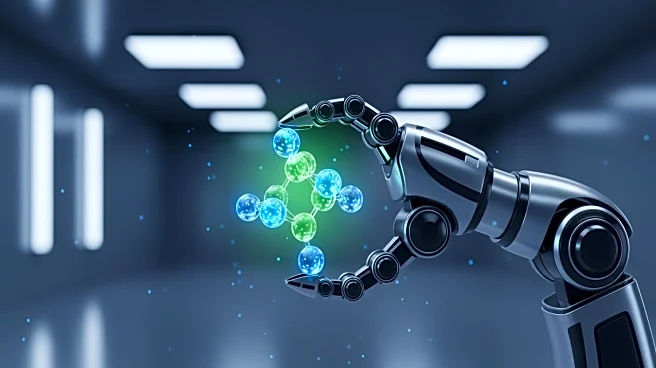
Medra, a San Francisco-based startup, is pioneering the development of Physical AI Scientists to transform biological research. These AI systems are designed to autonomously generate hypotheses, conduct experiments, and interpret results, addressing the current limitations in biological data generation. Unlike traditional automation, Physical AI integrates robotics with sensors to make intelligent decisions, similar to self-driving cars. Medra's approach aims to automate the scientific process itself, rather than just laboratory tasks, by leveraging AI to handle the variability and complexity inherent in biological research. The company recently secured $52 million in Series A funding, led by Human Capital, to further develop this technology.
Why It's Important?
The introduction of Physical AI in biological research could significantly accelerate the pace of scientific discovery and drug development. By automating the experimental process, Medra's technology has the potential to reduce the time and cost associated with bringing new drugs to market. This could lead to more rapid advancements in treating diseases, benefiting patients and healthcare systems. Additionally, the ability to generate large-scale data autonomously could enhance the development of AI models capable of predicting and curing diseases, marking a substantial shift in how biological research is conducted.
What's Next?
As Medra continues to develop its Physical AI technology, the company and its partners, including Genentech and Addition Therapeutics, are exploring how this innovation will impact the workforce and the broader field of life sciences. The focus will be on scaling the technology to handle more complex biological tasks and integrating it into existing research frameworks. The success of this initiative could prompt other companies to adopt similar technologies, potentially leading to widespread changes in the industry.
Beyond the Headlines
The deployment of Physical AI in biological research raises questions about the future role of human scientists. While the technology promises to enhance efficiency and data generation, it also challenges traditional scientific methods and the artisanal nature of laboratory work. Ethical considerations regarding data privacy and the potential displacement of jobs in the scientific community will need to be addressed as the technology becomes more prevalent.