

What's Happening?
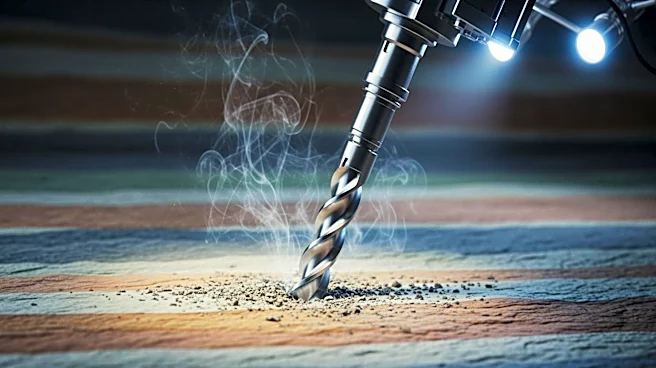
A recent study conducted at the Staszic–Wujek Coal Mine in Poland has demonstrated the effectiveness of integrating directional drilling with geo-mechanical and ventilation modeling to improve methane drainage in deep coal mines. The research highlights
how directional drilling allows for more precise borehole paths into methane-bearing zones, which are challenging to reach with conventional methods. This approach has been shown to significantly enhance methane capture, especially in the early stages of mining when stress-relieved fracture zones are well developed. The study utilized field measurements, laboratory testing, and numerical modeling to assess methane drainage performance, comparing conventional and directional boreholes. The findings suggest that directional boreholes initially accounted for a substantial portion of methane drainage, although their effectiveness decreased as mining progressed and adjacent panels became interconnected.
Why It's Important?
The study's findings are significant for the mining industry, particularly in regions where methane poses a safety hazard. By improving methane drainage, the risk of methane-related incidents can be reduced, enhancing safety for miners. Additionally, the research provides a framework for optimizing methane drainage systems, which could lead to more efficient mining operations and reduced environmental impact. The integration of directional drilling with advanced modeling techniques offers a potential pathway for other mines facing similar geological and ventilation challenges. This approach not only improves safety but also contributes to more sustainable mining practices by minimizing methane emissions.
What's Next?
The study suggests that further research and development could focus on refining the integration of directional drilling with geo-mechanical and ventilation modeling to enhance methane drainage efficiency. Mines could adopt this framework to tailor their methane management strategies to specific geological conditions. Additionally, the findings could inform policy and regulatory frameworks aimed at improving safety and environmental standards in the mining industry. As the study was based on a single mine, further validation in different geological settings could help generalize the approach and encourage broader adoption.