







What's Happening?
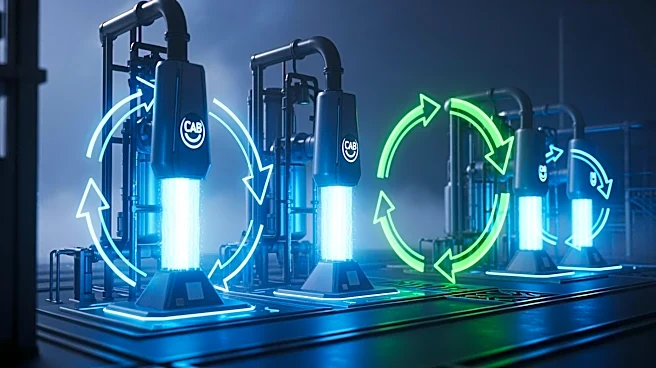
Carbon capture, utilization, and storage (CCUS) technologies are gaining traction as a means to reduce carbon dioxide emissions and promote a circular economy. These technologies capture CO2 from the atmosphere or flue gases, compress it, and then either
store or utilize it. According to IDTechEx, by 2025, 50 million tonnes of new CCUS capture capacity will be under construction, with numerous projects in development. However, large-scale implementation of CCUS will require financial incentives such as tax credits or government subsidies. The technology is particularly crucial for hard-to-decarbonize sectors like cement and steel production, as well as emerging sectors like blue hydrogen and bioenergy with carbon capture and storage.
Why It's Important?
The adoption of CCUS technologies is significant for the U.S. as it aligns with broader goals of reducing greenhouse gas emissions and transitioning to a more sustainable economy. By treating captured CO2 as a valuable raw material, industries can reduce their carbon footprint while creating new economic opportunities. The potential for enhanced oil recovery and the production of building materials, chemicals, and fuels from CO2 could lead to a more circular economy. This shift not only addresses environmental concerns but also positions the U.S. as a leader in innovative decarbonization technologies, potentially influencing global markets and policies.
What's Next?
For CCUS technologies to reach their full potential, further development and deployment are necessary. This includes building the infrastructure required for large-scale CO2 capture and utilization, as well as ensuring that captured CO2 can be economically integrated into various industrial processes. Policymakers may need to consider additional incentives to encourage investment in CCUS projects. As the market for CO2 utilization is expected to exceed $69 billion by 2036, stakeholders will likely focus on scaling up operations and exploring new applications for captured carbon.
Beyond the Headlines
The implementation of CCUS technologies raises several ethical and economic considerations. The cost of capturing and utilizing CO2 must be balanced against the environmental benefits and the potential for creating a truly circular economy. Additionally, the reliance on enhanced oil recovery as a primary application for captured CO2 may face scrutiny from environmental groups advocating for a reduction in fossil fuel dependency. Long-term, the success of CCUS technologies will depend on their ability to integrate seamlessly into existing industrial processes and contribute to net-zero emissions goals.