




What's Happening?
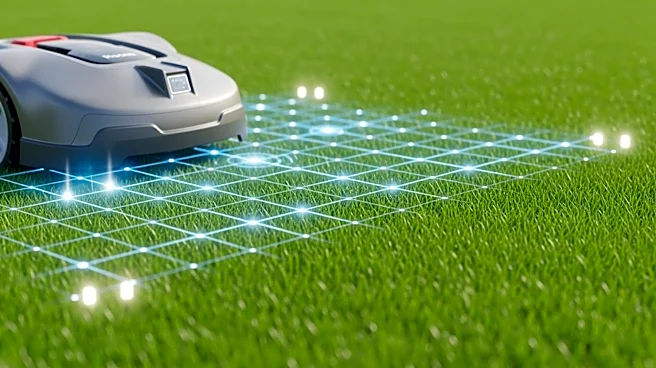
The robotic lawn mower industry is undergoing a significant transformation with the adoption of boundary-free systems. These systems utilize advanced technologies such as AI visual recognition, RTK high-precision positioning, and SLAM spatial mapping
to enhance navigation and safety. AI visual recognition, through cameras and deep learning algorithms, allows mowers to identify dynamic targets like lawn boundaries, obstacles, and pets, improving adaptability in complex environments. The shift from traditional boundary-line systems to boundary-free solutions is driven by the demand for smarter, more efficient, and user-friendly lawn care technology. This transition represents a move from rule-based automation to spatially intelligent autonomous systems, offering a plug-and-play user experience and better adaptation to dynamic garden environments.
Why It's Important?
The integration of AI and other advanced technologies in robotic lawn mowers is crucial for meeting the growing consumer demand for intelligent and autonomous garden equipment. This shift not only enhances user experience by reducing installation complexity and maintenance costs but also aligns with the broader trend of smart home devices moving towards autonomous operation. For manufacturers and end-users, boundary-free systems offer higher efficiency, scalability, and reduced costs, particularly in commercial landscaping and large-scale applications. As the technology matures, it is expected to drive long-term growth in the smart garden equipment industry, positioning robotic lawn mowers as key players in the market.
What's Next?
As boundary-free robotic lawn mowers continue to evolve, the industry faces challenges such as positioning stability in complex environments and the recognition of irregular obstacles. However, ongoing advancements in AI, positioning systems, and sensor fusion are expected to address these issues, enhancing system stability and intelligence. The industry is also moving towards standardization to overcome compatibility issues and reduce switching costs. As these challenges are resolved, the adoption of boundary-free systems is likely to accelerate, further transforming the landscape of smart garden equipment.