





What's Happening?
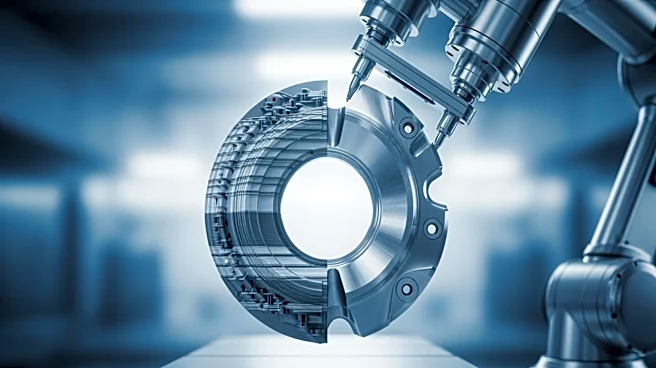
Hybrid manufacturing is revolutionizing the production process by combining additive manufacturing, such as 3D printing, with subtractive processes like CNC machining. This integration allows for the creation of complex geometries and the finishing of critical
surfaces with precision. The process begins with the creation of a preform using industrial 3D printing, which is then refined through CNC machining to complete features such as recesses, threads, and sealing surfaces. This method is particularly beneficial for producing high-value components and parts with complex geometries that are difficult to machine using traditional methods. The National Institute of Standards and Technology (NIST) has noted the challenges in post-processing or integrated machining of additive manufacturing parts, highlighting the need for precision in alignment and thermal management.
Why It's Important?
The significance of hybrid manufacturing lies in its ability to address specific constraints such as complex geometries, expensive materials, and low production volumes. This approach is particularly valuable in industries like aerospace, defense, and high-performance automotive, where precision and material efficiency are critical. By reducing material waste and improving the precision of complex parts, hybrid manufacturing can lead to cost savings and enhanced performance. Additionally, the ability to repair and restore critical components can significantly reduce lead times and downtime, providing a competitive advantage in sectors that rely on high-value, low-volume production.
What's Next?
As hybrid manufacturing continues to evolve, further integration of technologies such as closed-loop control and in-line inspection is expected. These advancements will enhance the precision and reliability of the manufacturing process, allowing for better prediction and correction of defects. The development of standards and qualifications for hybrid processes will also play a crucial role in ensuring consistency and quality across industries. As more sectors recognize the benefits of hybrid manufacturing, its adoption is likely to increase, driving innovation and efficiency in production processes.
Beyond the Headlines
The adoption of hybrid manufacturing could lead to significant shifts in manufacturing strategies, emphasizing the importance of flexibility and adaptability in production. This approach not only enhances the capabilities of existing manufacturing processes but also opens up new possibilities for design and material usage. The integration of additive and subtractive manufacturing techniques could redefine the boundaries of what is possible in industrial production, leading to more sustainable and efficient manufacturing practices.