






What's Happening?
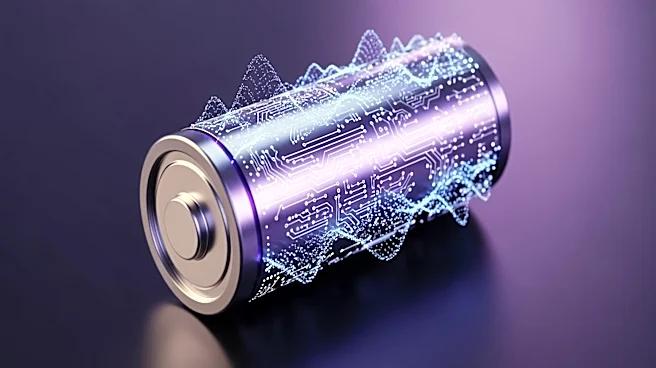
Researchers from CSIRO, RMIT University, and the University of Melbourne have developed a proof-of-concept quantum battery that could revolutionize energy storage and charging. Unlike traditional batteries that rely on chemical reactions, this quantum battery utilizes
principles of quantum physics, such as superposition and entanglement, to potentially offer faster charging and greater energy storage capacity. The prototype, a small layered organic device, can be charged wirelessly using a laser, demonstrating a new method of energy delivery without physical connections. This advancement marks a significant step towards practical quantum batteries, which could eventually outperform current energy-storage technologies.
Why It's Important?
The development of quantum batteries could have a profound impact on energy storage and delivery systems. By potentially offering faster charging times and greater efficiency, quantum batteries could transform industries reliant on energy storage, such as electric vehicles and renewable energy sectors. The ability to charge devices wirelessly and rapidly could lead to significant advancements in consumer electronics and transportation, reducing reliance on fossil fuels and enhancing energy sustainability. This technology could also drive innovation in energy infrastructure, leading to more efficient and environmentally friendly solutions.
What's Next?
The research team is focused on extending the charge retention time of quantum batteries, a critical factor for their commercial viability. As the technology progresses, further research and development will be necessary to overcome current limitations and move towards real-world applications. The potential for quantum batteries to charge electric vehicles faster than traditional fuel methods presents a promising future for the automotive industry. Continued advancements could lead to widespread adoption, influencing energy policies and market dynamics.