
What's Happening?
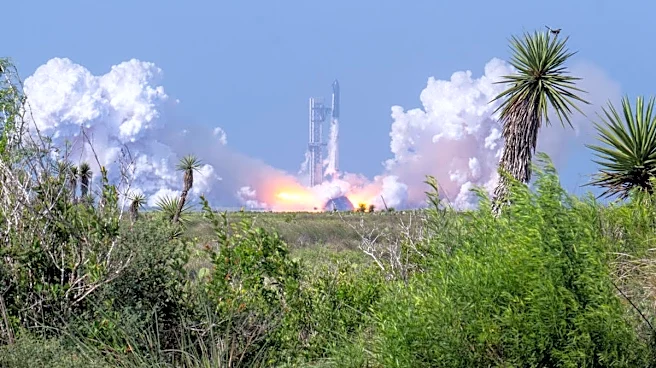
A recent test launch of SpaceX's Starship megarocket was captured in stunning slow-motion video, revealing shockwaves as the rocket blasted off. The footage, filmed at 120 frames per second by Interstellar
Gateway, shows pressure waves emanating from the 400-foot rocket as it launched. These shockwaves, typically invisible to the naked eye, were made visible due to the high exhaust velocity of the Raptor engines, which exceed the speed of sound. The slow-motion video allows viewers to see the supersonic exhaust forming visible shockwaves, a phenomenon that is usually fleeting at normal speed. The launch, which took place on May 22, 2026, was SpaceX's twelfth test flight of the Starship and involved the new Starship V3 prototype. Despite operating without one of its engines, the rocket successfully released mock satellites and made a splashdown in the Indian Ocean.
Why It's Important?
The successful test of the Starship V3 is a significant milestone for SpaceX, as it demonstrates the progress of the upgraded vehicle. This is crucial for SpaceX's future plans, including a potential $1.75 trillion IPO. The ability to visualize shockwaves in slow motion not only showcases the engineering prowess behind the Starship but also provides valuable insights into the rocket's performance. This test flight serves as proof to investors that the Starship program is advancing in the right direction, which is essential for securing future funding and support. The success of the Starship is also pivotal for SpaceX's long-term goals, including missions to Mars and beyond.
What's Next?
Following the successful test of the Starship V3, SpaceX is likely to continue refining and testing its megarocket technology. The company will focus on addressing any issues identified during the test flight and further improving the vehicle's performance. As SpaceX moves closer to its goal of launching commercial missions, the company will need to ensure the reliability and safety of the Starship. The progress of the Starship program will be closely monitored by investors and industry stakeholders, as it plays a critical role in SpaceX's future endeavors, including interplanetary travel and satellite deployment.