

What's Happening?
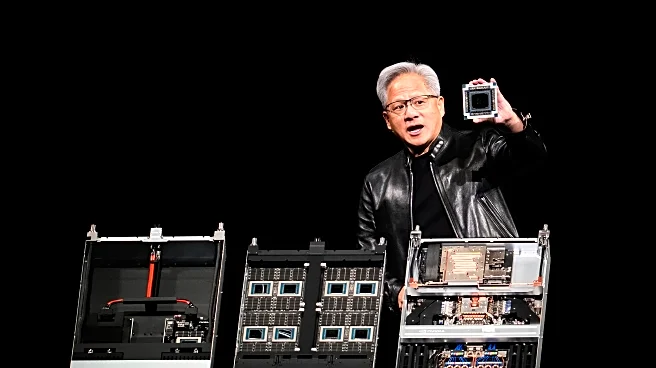
Nvidia CEO Jensen Huang announced during the company's annual GTC Conference in San Jose, California, that the company projects $1 trillion in orders for its Blackwell and Vera Rubin chips. This projection reflects a significant increase from the $500
billion demand reported last year. The Rubin chip architecture, introduced in 2024, is described as state-of-the-art AI hardware, outperforming its predecessor, Blackwell. The Rubin chips are expected to operate 3.5 times faster on model-training tasks and 5 times faster on inference tasks, reaching up to 50 petaflops. Nvidia plans to ramp up production in the latter half of the year.
Why It's Important?
This projection underscores the growing demand for advanced AI hardware, highlighting Nvidia's pivotal role in the AI industry. The anticipated $1 trillion in sales signifies a substantial economic impact, potentially boosting Nvidia's market position and influencing the broader tech sector. As AI continues to integrate into various industries, the demand for high-performance computing solutions like Nvidia's chips is expected to rise, driving innovation and competition in the tech market. This development could also affect stock market dynamics, investor confidence, and the strategic direction of competing tech firms.
What's Next?
Nvidia's focus will likely be on scaling production to meet the projected demand, which could involve expanding manufacturing capabilities and supply chain operations. The company may also continue to innovate and enhance its chip architectures to maintain a competitive edge. Stakeholders, including investors and tech industry players, will be closely monitoring Nvidia's production and sales performance, as well as any strategic partnerships or acquisitions that may arise from this growth trajectory.