


What's Happening?
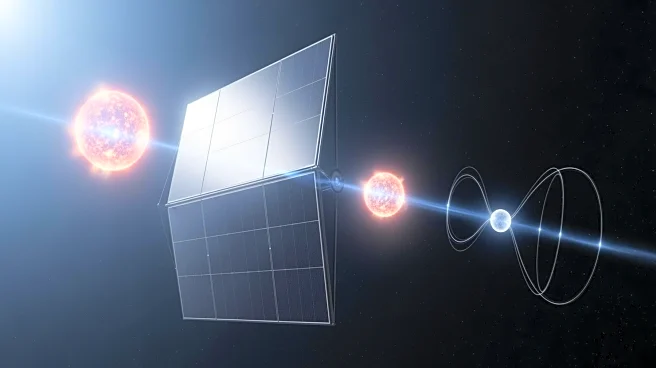
Momentus Inc. has been awarded a contract by NASA to support the Space Storms Solar Sail Sentinel Demonstration Study. This initiative is focused on developing a solar sail, in collaboration with NASA and the National Oceanic and Atmospheric Administration
(NOAA), to enhance space weather monitoring capabilities. The solar sail is designed to allow satellites to maneuver closer to the sun, thereby providing earlier warnings of solar weather events such as geomagnetic storms. The study, completed by Momentus, involved the cislunar-capable Vigoride spacecraft platform and aimed to demonstrate the potential of solar sails in space navigation. The solar sail, measuring 1,652 square meters, would enable satellites to measure solar wind further from Earth, increasing response time to critical solar events.
Why It's Important?
The development of solar sails represents a significant advancement in space technology, offering a new method for spacecraft propulsion that does not rely on conventional propellants. This technology could revolutionize how satellites are positioned and maneuvered in space, particularly for missions requiring proximity to the sun. By improving the ability to monitor solar weather, this project could enhance the protection of Earth's technological infrastructure from solar storms, which can disrupt communications, navigation systems, and power grids. The success of this project could lead to further investments in solar sail technology, potentially opening new avenues for space exploration and satellite deployment.
What's Next?
Following the completion of the study, NASA may consider awarding a follow-up contract for a flight demonstration of the solar sail. This would involve selecting a hosted orbital platform provider responsible for integrating the solar sail technologies. The demonstration would be managed under NASA’s Flight Opportunities program, potentially leading to broader adoption of solar sail technology in future space missions. The outcome of this demonstration could influence future NASA projects and partnerships with private space companies.