





What's Happening?
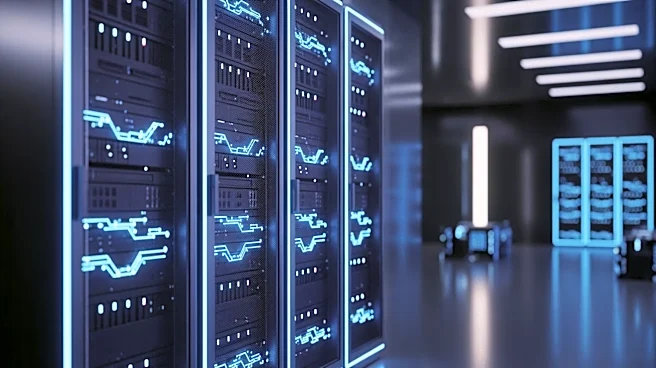
The rapid expansion of AI infrastructure in Silicon Valley is encountering a significant challenge due to the limitations of copper wiring. As AI systems scale up, the reliance on copper for data transmission is becoming a bottleneck, primarily due to issues
with heat, distance, and power consumption. To address these challenges, companies are turning to photonics, which uses light instead of electrical signals to transmit data. Lightmatter, a startup in Silicon Valley, is at the forefront of this shift, developing photonics hardware that allows data to move faster and more efficiently over longer distances. This technology is becoming crucial as AI models require the connection of hundreds or thousands of GPUs, which copper wiring struggles to support effectively.
Why It's Important?
The shift from copper to photonics in AI infrastructure is significant for several reasons. Firstly, it addresses the physical limitations of copper, such as signal degradation and heat generation, which are critical as AI models become more complex and require more extensive data processing capabilities. By adopting photonics, companies can enhance the performance and efficiency of AI systems, potentially reducing energy consumption and operational costs. This transition also represents a competitive advantage for early adopters, as it allows for faster model training and deployment. As AI continues to drive technological advancements, the ability to efficiently manage and process large volumes of data will be a key differentiator in the industry.
What's Next?
As the demand for more efficient AI infrastructure grows, it is likely that more companies will invest in photonics technology. This could lead to significant changes in data center design and operations, with a focus on optimizing cooling and reducing energy consumption. Additionally, as manufacturing techniques for photonics improve, the cost of implementation may decrease, making it more accessible to a broader range of companies. The collaboration between Lightmatter and Nvidia suggests that major players in the AI hardware space are already recognizing the potential of photonics, which could accelerate its adoption across the industry.
Beyond the Headlines
The transition to photonics in AI infrastructure could have broader implications beyond immediate technological improvements. It may influence the future design of data centers, emphasizing sustainability and energy efficiency. Furthermore, as photonics becomes more prevalent, it could spur innovation in other areas of technology, such as telecommunications and networking, where similar challenges with data transmission exist. The shift also highlights the importance of continued investment in research and development to overcome physical limitations and drive technological progress.